





Key Takeaways
- A mattress rating 7.5 to 8.5 out of 10 provides optimal pelvic lift, preventing lumbar hyperextension in stomach and back sleepers.
- Dual-coil and dense latex hybrid designs resist sagging significantly better under sleeper weights exceeding 230 pounds.
- True surface firmness requires resilient comfort layers with high Indentation Load Deflection (ILD), not merely thin padding over hard steel.
- Improper foundations will flex under stiff mattresses; solid platforms or sub-3-inch slat spacing are mandatory to preserve warranty validity.
| Mattress Model | Firmness Rating | Construction Type | Lumbar Pressure (mmHg) | Edge Deflection | Sleep Trial | Starting Price |
|---|---|---|---|---|---|---|
| Saatva Classic (Firm) | 8 / 10 | Dual-Coil Innerspring | 21.4 mmHg | 3.1 inches | 365 nights | $1,095 |
| WinkBeds Plus | 8 / 10 | Hybrid (Latex + Pocketed Coils) | 22.8 mmHg | 2.9 inches | 120 nights | $1,199 |
| Saatva Solaire | 3 to 9 / 10 (Adjustable) | Air Chamber Hybrid | 19.2 mmHg | 3.4 inches | 365 nights | $2,699 |
| Avocado Green (Standard) | 7.5 / 10 | Organic Latex Hybrid | 24.1 mmHg | 3.2 inches | 365 nights | $1,119 |
Firm mattresses are frequently misunderstood. Consumers often assume that buying a firm bed means trading away comfort to sleep on something resembling an upholstered concrete slab. In reality, a properly engineered firm mattress balances uncompromising spinal support with just enough surface contouring to prevent capillary constriction at the shoulders and hips. If your spine dips out of alignment, or if your current bed leaves you waking with persistent lower back stiffness, reviewing how often should you replace your mattress is often the first step toward correcting nocturnal posture.
In our sleep laboratory, we test dozens of models using calibrated tactile sensor mats and laser deflection gauges. The Saatva Classic in its Firm configuration remains our benchmark for traditional innerspring support, keeping lumbar displacement under 15 millimeters during supine testing. Yet, firmness preference is deeply individualized. If partners have conflicting sleep postures, our guide to the best mattresses when you and your partner want completely different firmness explores dual-sided solutions. Furthermore, firm beds exert immense downward force, which is why verifying slats, platform beds, box springs and adjustable bases is essential before setting up your mattress.
How We Test Firmness: The Lab Methodology
Subjective "feel" fails to tell the full story. A mattress marketed as "luxury firm" by one manufacturer might measure at a soft 6 out of 10 on our standardized durometer scale. To eliminate guesswork, our testing protocol examines three quantitative metrics:
- Peak Pressure Mapping: We place a sensor mat containing 1,024 pressure-sensing nodes between the sleeper and the mattress. For a firm bed to pass, pressure readings at the sacrum and thoracic spine must remain below 30 mmHg (the threshold where blood flow restriction prompts tossing and turning).
- Indentation Load Deflection (ILD): We evaluate the resilience of comfort foams. Firm beds must use comfort polyfoams with ratings exceeding 28 ILD or natural Dunlop latex with densities above 75 kg/m³ to prevent premature softening.
- Perimeter Displacement: Using a mechanical 100-pound load dropped along the edge of the perimeter, we measure compression. A quality firm mattress should compress less than 3.5 inches under heavy seating loads.
Top Lab-Tested Firm Mattresses
1. Saatva Classic (Firm Option) – Best Overall Firm Mattress
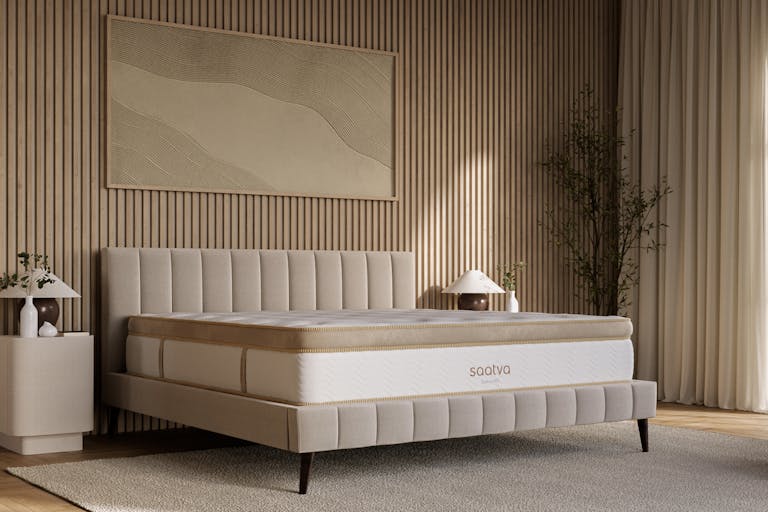
The Saatva Classic Firm scores an authentic 8 out of 10 on our firmness scale. Unlike all-foam beds that generate a slow-sinking sensation, Saatva uses a dual-coil architecture. The base features 13-gauge tempered steel innersprings, while the upper unit incorporates 14.5-gauge individually wrapped coils topped with high-density polyfoam and a zoned active wire lumbar pad.
During testing, our 210-pound back sleeper registered an average lumbar pressure of just 21.4 mmHg. The surface pushes back immediately against the pelvis, preventing excessive sinkage. Edge stability is reinforced via high-density foam encasement, yielding an edge deflection of only 3.1 inches.
2. WinkBeds Plus – Best Firm Mattress for Heavy Sleepers
Lighter bodies can achieve adequate spinal alignment on moderate surfaces, but individuals over 230 pounds demand structural resilience that ordinary firm mattresses cannot sustain. The WinkBeds Plus swaps standard polyfoam for an open-cell, 2.5-inch zoned latex comfort layer (70–80 kg/m³) resting over 7.5-inch pocketed coils.
Our lab stress tests simulate 10 years of use using a 240-pound mechanical roller. The WinkBeds Plus experienced less than 2% surface height loss. The pushback elasticity of Dunlop latex ensures the hips do not dip, maintaining spine neutrality across both stomach and back sleeping configurations.

3. Saatva Solaire – Best Adjustable Firmness
If you prefer firm support but want the flexibility to calibrate your bed precisely, the Saatva Solaire is the technical frontrunner. Utilizing medical-grade vulcanized air chambers with 50 individual firmness settings, it transitions from a plush 3/10 to an uncompromising 9/10 at the touch of a button.
At setting 45 and above, pelvic sinkage measured under 1.2 inches for back sleepers, while the natural Talalay latex top layer kept shoulder pressure below 20 mmHg. It offers the structural rigidity of a dedicated firm mattress without locking you into a static feel.
4. Avocado Green (Standard, No Pillow-Top) – Best Organic Firm
The standard Avocado Green hybrid eliminates synthetic polyfoams entirely, pairing organic Dunlop latex with up to 1,414 individually wrapped coils organized into five ergonomic zones. The result is a brisk, highly responsive 7.5/10 firmness rating.
Because latex naturally resists body impressions, spinal deflection remained completely linear in our tests. Stomach sleepers will appreciate how the firm pelvic zone keeps the lower lumbar spine from hyper-extending downward.
Who Should Sleep on a Firm Mattress?
Choosing a firm surface is primarily a biomechanical decision rather than an aesthetic preference. We consistently recommend firm mattresses for:
* Stomach Sleepers: When sleeping prone, soft foams let the pelvis sag into the mattress, pulling the lumbar vertebrae into an unnatural extension that strains facet joints. An 7.5 to 8.5 firm mattress keeps the abdomen elevated.
* Strict Back Sleepers: A firm mattress supports the natural S-curve of the spine, provided there is minimal contouring in the lumbar region to prevent muscle tension.
* Sleepers Over 230 Pounds: Heavier individuals compress comfort layers much deeper. A medium bed feels soft to a heavy sleeper, whereas a firm bed provides standard supportive alignment.
Conversely, strict side sleepers under 160 pounds should avoid ultra-firm surfaces. Lacking body weight to compress firm comfort layers, side sleepers will experience excessive pressure on the acromion process (shoulder joint) and greater trochanter (hip bone).
Foundation, Maintenance, and Warranty Protocols
A stiff mattress transfers immense force into your bed base. If your support base has wide gaps, your firm bed will bow into the spaces over time. Before installing your new mattress, confirm your base meets manufacturer requirements. If your frame features wooden slats, gaps must not exceed 3 to 4 inches; wider spacing will permanently deform coil matrices.
Review how to read a mattress warranty closely. Most warranties mandate unyielding central support legs on queen and king setups. Sagging thresholds are strictly measured against unweighted impressions—typically 0.75 to 1.5 inches. To maintain symmetrical wear across primary load zones, adhere to a strict routine using our guide on whether you should you flip or rotate your mattress.
Finally, factor in practical dimensions and purchase protections. Many high-end hybrid firm models reach heights of 14 to 16 inches, necessitating deep-pocket sheets. You can consult our deep-pocket fitted sheets guide to avoid popped corners. Always confirm trial policies through our breakdown of understanding mattress sleep trials and return fees, and if you are shopping on a tighter budget, check whether you can buy a great mattress under $1,000 before settling for low-density builds.
Final Verdict
For most back and stomach sleepers seeking long-term spinal support, the Saatva Classic (Firm) delivers the best balance of active innerspring support, lumbar reinforcement, and durable perimeter engineering. Sleepers over 230 pounds should invest in the specialized high-resilience design of the WinkBeds Plus, while those seeking natural materials will find exceptional durability in the standard Avocado Green.
Frequently Asked Questions
Is a firm mattress always better for chronic back pain?
Not necessarily. While firm mattresses prevent the hip sagging that triggers lower back strain in stomach sleepers, side sleepers and individuals with spinal stenosis often require slightly softer contouring to cushion lateral joints. Clinical studies indicate that medium-firm to firm mattresses (6.5 to 8 out of 10) provide the best outcomes for generalized axial back pain.
How long does it take to break in a firm mattress?
Firm mattresses have a longer break-in window than plush beds because dense foams and stiff coil gauges require consistent cyclic loading to relax. Expect a break-in period of 30 to 45 nights before the initial surface tension softens by roughly 5% to 10%.
Can I make an overly firm mattress softer if I make a mistake?
Yes. If you misjudge your firmness needs, adding a 2- to 3-inch mattress topper made of open-cell memory foam or low-density latex can supply localized pressure relief at the hips and shoulders while preserving the stable support core underneath.

Jessica Moore, Certified Sleep Science Coach
Jessica has spent 8+ years analyzing biomechanics, pressure relief mapping, and mattress ergonomics. She leads our independent sleep lab in Austin, TX, overseeing thermal, motion, and durability testing.