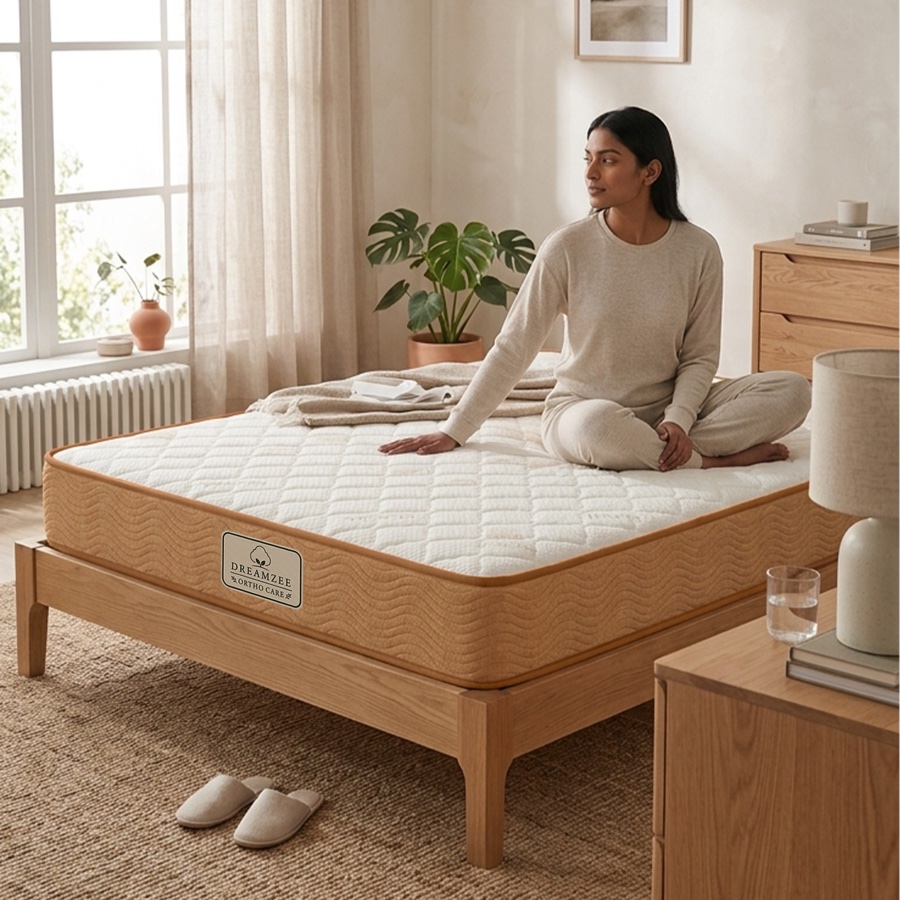
Nectar wins on pressure relief and motion isolation, while DreamCloud takes cooling and responsive support.
Nectar Memory Foam
12" Gel Memory Foam | Starting at $349
- Near-zero motion transfer (9.9/10 lab score)
- Exceptional hip and shoulder pressure dispersion
- Lower entry price point with a 365-night trial
DreamCloud Hybrid
12" Pocketed Coil Hybrid | Starting at $499
- Airflow-promoting coil core keeps sleepers cooler
- Faster response time makes changing positions easy
- Sturdier perimeter support for edge-sitters
Key Takeaways
- Nectar Memory Foam offers superior surface contouring and motion deadening (9.9/10), making it better for restless couples and side sleepers under 230 lbs.
- DreamCloud provides stronger perimeter pushback (8.9/10 edge support) and superior thermal dissipation via its pocketed coil array.
- Both brands share parent company Resident Home, offering identical 365-night home sleep trials and lifetime warranty policies.
- Back and stomach sleepers benefit from DreamCloud's 6.5/10 luxury firm lift, while dedicated side sleepers prefer Nectar's 6/10 pressure-relieving sink.
| Lab Metric / Feature | Nectar Memory Foam | DreamCloud Hybrid |
|---|---|---|
| Overall Score | 9.7 / 10 | 9.3 / 10 |
| Construction | All-Foam (Gel Memory Foam) | Pocketed Coil Hybrid |
| Firmness Rating | 6 / 10 (Medium-Firm) | 6.5 / 10 (Luxury Firm) |
| Profile Height | 12 inches | 12 inches |
| Pressure Relief | 9.8 / 10 | 9.2 / 10 |
| Motion Isolation | 9.9 / 10 | 9.1 / 10 |
| Cooling Score | 8.9 / 10 | 9.0 / 10 |
| Edge Support | 8.8 / 10 | 8.9 / 10 |
| Starting Price | $349 | $499 |
| Trial & Warranty | 365 Nights / Forever Warranty | 365 Nights / Lifetime Warranty |
Few match-ups generate as much curiosity among shoppers as Nectar versus DreamCloud. Both built their reputations under parent company Resident Home, and both consistently rank on our list of the Best Mattress in a Box options on the market. However, their structural DNA takes fundamentally different paths. The flagship Nectar Memory Foam relies on a dense, multi-layer foam stack engineered to isolate motion and cradle high-impact joints, whereas the DreamCloud builds upon an individually wrapped steel coil core topped with quilted polyfoams and cashmere-blend fibers.
Deciding between an all-foam build and a coil hybrid involves clear mechanical trade-offs in airflow, edge stability, and body support. If you want upgraded cushioning, you might also compare models like the plush DreamCloud Premier or evaluate our Nectar Premier vs DreamCloud breakdown. In this head-to-head analysis, we break down our rigorous laboratory tests to reveal exactly how the standard Nectar and baseline DreamCloud perform across pressure relief, thermal regulation, motion transfer, and edge stability.
Construction and Materials: Foam Sink vs. Hybrid Pushback
The Nectar Memory Foam measures a true 12 inches in height. Beneath its breathable, poly-blend cover sits a 2-inch comfort layer of therapeutic gel memory foam. This layer is designed to conform directly to body heat and weight. Beneath that lies a 3-inch dynamic response transition foam layer that prevents the sleeper from bottoming out, supported by a 7-inch high-density base foam foundation. It is a slow-responding, doughy structure that hugs the silhouette and eliminates surface vibrations.
DreamCloud also stands 12 inches tall, but its internal mechanics are entirely different. The mattress begins with a cashmere-blend quilted Euro top, followed by 1.5 inches of pressure-relieving gel foam and a transition foam buffer. The primary workhorse of the DreamCloud is an 8.5-inch unit of individually wrapped steel pocketed coils resting on a thin base foam layer. While Nectar relies on progressive foam density to arrest downward body load, DreamCloud couples thin contouring foam with the active upward resistance of steel springs. If you prefer springs but want Nectar's specific foam feel, you can also explore the Nectar Classic Hybrid.
Firmness, Feel, and Sleep Position Compatibility
On our standardized 1-to-10 firmness scale, we rate the Nectar Memory Foam at a 6 out of 10 (Medium-Firm). When you lie down, there is an immediate 1-to-2-second delay before the memory foam softens under your mass, yielding a classic "in-the-mattress" contour. Side sleepers under 230 pounds receive outstanding shoulder and pelvic immersion, allowing the spine to stay completely level.
DreamCloud clocks in slightly firmer at a 6.5 out of 10 (Luxury Firm). The quilted cashmere top offers initial surface fluff, but your body quickly encounters the buoyant pushback of the coil unit. You rest "on top" of DreamCloud rather than sinking into it. This added mechanical lift makes DreamCloud a superior choice for back and combination sleepers, earning high marks when assessing the Best Mattress for Back Pain. Stomach sleepers under 200 pounds will also appreciate DreamCloud's ability to keep the hips elevated without bowing the lumbar spine.
Pressure Relief: Lab Sensor Mapping
To measure pressure relief, we deploy an ultra-thin 1,024-sensor diagnostic mat directly beneath our test subjects in the side, back, and stomach positions. Warm colors (red and orange) denote high pressure spikes above 32 mmHg—the clinical threshold where capillary blood flow is restricted—while cool colors (blue and green) indicate healthy load dispersion.
Nectar is a standout performer in this category, scoring a 9.8 out of 10. For side sleepers, the sensor mat shows a field of unbroken blue around the humerus and greater trochanter, with zero high-pressure hot spots. The memory foam conforms intimately to the lateral curvature of the torso. DreamCloud registers a commendable 9.2 out of 10. While the Euro top relieves basic surface tension, our heavier testers (over 200 pounds) experienced small pockets of yellow pressure around the hip joint when side-sleeping, where the underlying coil unit resisted full pelvic sinkage.
Motion Transfer and Bounce
Motion isolation is critical for light sleepers sharing a bed. In our lab, we drop a 15-pound kettlebell from heights of 4, 8, and 12 inches onto one side of the mattress while capturing kinetic energy dispersion with tri-axial accelerometers placed 18 inches away.
Nectar dominates this test with a near-perfect 9.9 out of 10 score. The viscoelastic foam completely deadens shock waves, showing less than 0.15G of lateral movement during our kettlebell drop. A partner shifting, turning, or getting out of bed will not disturb you. This performance puts it in regular contention on our Best Mattress for Couples list, similar to how it performs in our Nectar vs Casper evaluation.
DreamCloud registered a 9.1 out of 10. The pocketed coils are individually wrapped in fabric to prevent mechanical chain reactions, so motion transfer is far lower than on traditional innersprings. However, the steel springs inherently produce more residual bounce than all-foam, meaning extremely light sleepers will register sharp movements across the mattress.
Thermoregulation and Edge Support
Heat retention is often the Achilles' heel of memory foam. To quantify breathability, our team uses FLIR thermal imaging cameras. We record surface temperatures before a sleeper enters, after 30 minutes of continuous rest, and at 2-minute increments post-exit to measure the cool-down rate.
DreamCloud scored 9.0 out of 10 in cooling. The open spaces between its 8.5-inch pocketed coils permit ambient air to circulate continuously with every movement, venting trapped body warmth efficiently. Nectar registered 8.9 out of 10. Although its gel infusions and polyethylene-blend cover perform well above average for an all-foam mattress, solid foam cores simply cannot circulate airflow at the velocity of a coil hybrid.
For edge support, our load-deflection sensor tests structural integrity along the absolute perimeter. DreamCloud compressed 3.4 inches under a 200-pound seated edge load, recovering instantly thanks to its reinforced perimeter coils (8.9/10 score). Nectar compressed 3.8 inches (8.8/10 score). While Nectar's edge is robust for foam, DreamCloud provides a slightly more secure border when sitting to lace shoes or sleeping right at the brink.
Setup, Expansion, and Off-Gassing
Both mattresses ship compressed in compact cardboard boxes. When unboxing foam beds, off-gassing and foam expansion require attention. We recommend reviewing our guide on How Long Does a Mattress in a Box Take to Expand? (Plus Off-Gassing Tips). In our tests, DreamCloud reached 95% of its full height within two hours due to coil decompression, while Nectar required roughly 24 to 36 hours for its dense viscoelastic core to normalize. Standard depth bedding fits both 12-inch beds easily, though if you upgrade to thicker models, refer to our Deep-Pocket Fitted Sheets Guide: Matching Sheet Depth to 12"–16" Mattresses.
The Final Verdict
Both models offer exceptional consumer protections: a risk-free 365-night home trial and a lifetime warranty. Your choice should hinge entirely on your sleep posture and physical build:
- Choose the Nectar Memory Foam if you sleep primarily on your side, prioritize pinpoint pressure relief around your shoulders and hips, or share your bed with a restless partner who wakes you with every turn.
- Choose the DreamCloud Hybrid if you sleep on your back or stomach, sleep hot, prefer a buoyant "on top" feel that facilitates easy repositioning, or want the airflow advantages of pocketed coils.
If you want an even firmer, traditional innerspring feel, check out our Saatva vs DreamCloud comparison before making your final investment.
Frequently Asked Questions
Which is softer, Nectar or DreamCloud?
Nectar is slightly softer, rating 6 out of 10 on the firmness scale compared to DreamCloud's 6.5 out of 10. Nectar provides noticeably more surface sink and body contouring, whereas DreamCloud maintains a flatter, firmer plane of support.
Is DreamCloud better for heavy sleepers than Nectar?
Yes. Sleepers weighing over 230 pounds require the structural pushback of steel coils to keep their hips from sinking too deeply. DreamCloud's pocketed coil base offers better lumbar support and durability for heavier individuals than Nectar's all-foam foundation.
Do Nectar and DreamCloud sleep hot?
DreamCloud sleeps cooler than Nectar because its pocketed coil core allows heat to vent freely between springs. While Nectar features gel infusions to mitigate heat retention, foam inherently holds onto more body warmth than an open hybrid design.
Jessica Moore, Certified Sleep Science Coach
Jessica has spent 8+ years analyzing biomechanics, pressure relief mapping, and mattress ergonomics. She leads our independent sleep lab in Austin, TX, overseeing thermal, motion, and durability testing.