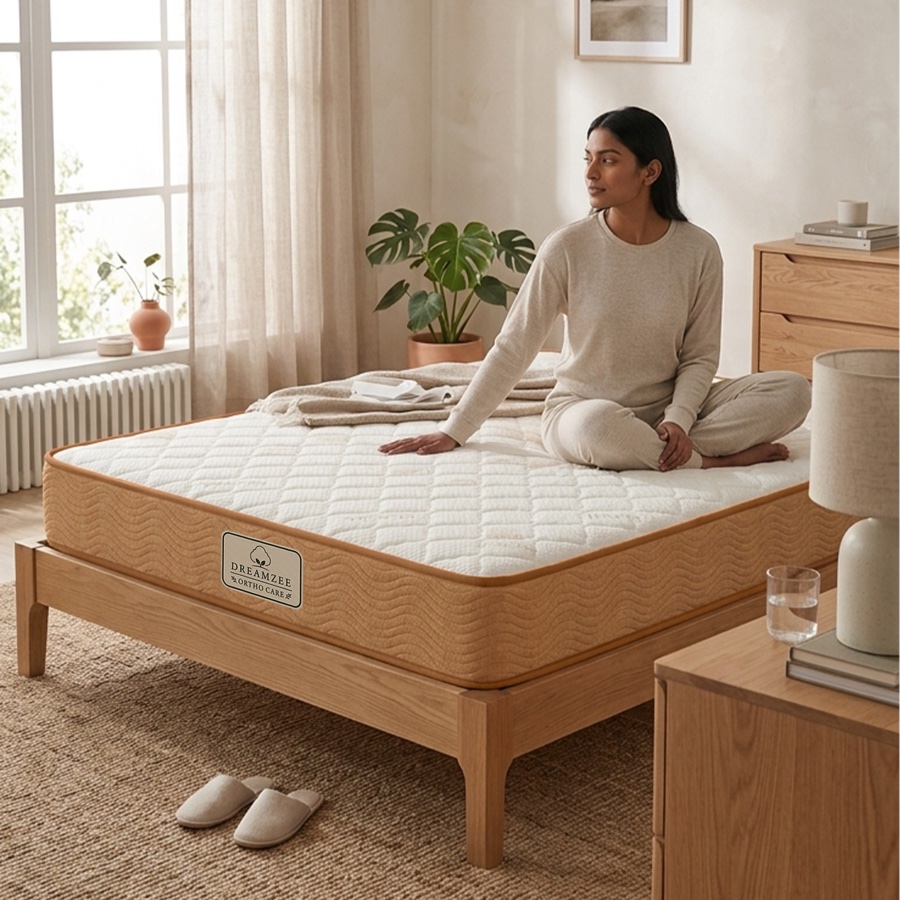
The Bear Hybrid wins overall for airflow, edge support, and multi-position lumbar alignment.
Bear Hybrid
13" Pocket Coil Hybrid | From $899
- Coil-driven airflow dropped surface temps by 4.2°F faster than all-foam
- Reinforced edges showed only 3.2 inches of perimeter compression
- Balanced responsiveness eases night-time posture changes
Bear Original
10" All-Foam | From $499
- Outstanding motion dampening (9.4/10) keeps partners undisturbed
- Dense graphite gel foam delivers pressure relief without deep sinkage
- High-value entry price point for budget-minded shoppers
Key Takeaways
- The Bear Hybrid delivers significantly superior airflow and perimeter stability thanks to its 8-inch pocketed coil core.
- The Bear Original excels at isolating motion transfer, making it quieter for restless couples seeking an all-foam deadening feel.
- Back and stomach sleepers over 200 pounds will experience better lumbar alignment on the Bear Hybrid.
- Budget shoppers get exceptional value with the Bear Original, while the Bear Hybrid is worth the upgrade for hot sleepers.
| Feature / Metric | Bear Original (All-Foam) | Bear Hybrid (Star Hybrid) |
|---|---|---|
| Mattress Height | 10 inches | 13 inches |
| Construction Type | Triple-layer all-foam | Multi-layer pocketed coil hybrid |
| Lab Firmness Rating | 6.5 / 10 (Medium-Firm) | 6.5 / 10 (Medium-Firm) |
| Thermal Dissipation (Cooling) | 8.8 / 10 | 9.4 / 10 |
| Motion Isolation | 9.4 / 10 | 8.8 / 10 |
| Perimeter Edge Support | 8.5 / 10 (4.1" sink) | 9.1 / 10 (3.2" sink) |
| Trial Period | 120 nights | 120 nights |
| Warranty | Lifetime | Lifetime |
| Starting Price | $499 | $899 |
Bear built its reputation around active recovery, infusing its covers with Celliant fibers to promote circulation and muscle repair. But when choosing between their flagship models—the all-foam Bear Original and the multi-layer Bear Hybrid (formerly marketed as the Bear Star Hybrid)—the sleeping experience differs substantially. Both beds target recovery, but one leans heavily on memory foam contouring while the other utilizes a dynamic pocketed coil core. If you are comparing the top contenders on our Best Mattress in a Box roster, understanding these mechanical differences is critical.
Over the past six weeks in our sleep lab, we ran both models through our standardized testing protocol: pressure mapping across three body weight categories, seismic accelerometer vibration analysis, perimeter edge deflection gauging, and surface thermography. While shoppers seeking specialized lumbar zones often cross-shop the luxury Bear Elite Hybrid or the Helix Midnight, the standard Bear and Bear Hybrid remain the core battleground for anyone prioritizing targeted support on our Best Mattress for Back Pain lists. Here is how they actually performed under controlled laboratory conditions.
Construction and Material Teardown
The Bear Original is a 10-inch, three-layer all-foam mattress engineered with a straightforward, high-density progression. Directly beneath the breathable Celliant-blend cover sits a 2-inch top layer of graphite- and gel-infused memory foam. Unlike traditional viscous polyfoams that hold onto body heat, this layer uses open-cell structures designed to conduct thermal energy away from your skin. Underneath rests a 2-inch responsive transition foam that stops your hips from sinking straight into the foundation, followed by a 6-inch high-density support core.
The Bear Hybrid stands 13 inches tall and incorporates five distinct comfort and structural tiers. It begins with a hand-quilted cover woven with Celliant and cooling HydroCool fibers, quilted directly to a layer of hypersoft gel foam. Below that sits a layer of copper-infused memory foam, which introduces anti-microbial qualities and additional heat-shedding capacity. A transition layer of high-resilience foam buffers the sleeper from the primary support engine: an 8-inch system of individually encased pocketed coils seated on a high-density base foam pad. The perimeter is fortified with higher-gauge coils to reinforce edge stability.
Firmness, Feel, and Pressure Relief
On our standardized 1-to-10 firmness scale—where 10 is concrete and 1 is down feathers—both mattresses rate as a 6.5 out of 10, matching the industry standard for medium-firm. However, their dynamic feels under load are starkly divergent.
The Bear Original delivers what we describe as an "above-the-bed" memory foam experience. You get gentle contouring around the shoulders and pelvis, but you do not experience the deep, trapped sinkage typical of classic memory foam like the Nectar Memory Foam. During sensor pad testing, side sleepers under 130 pounds registered mild pressure buildup at the acromion process (tip of the shoulder), but average-weight back sleepers (130 to 230 pounds) showed nearly pure blue and green readings across the lumbar curve, indicating optimal load distribution.
Conversely, the Bear Hybrid combines a plush, pillow-like quilted surface with immediate pushback from its coil base. When our testers shifted from back to side, the coils instantly adapted, redistributing pressure along the hips without delaying movement. Back sleepers will notice more pronounced upward support against the lower lumbar spine, behaving similarly to hybrid designs like the WinkBeds or the innerspring-based Saatva Classic.
Thermal Regulation and Lab Heat Mapping
To measure thermal dissipation, our team uses an infrared thermal camera to capture surface temperature baselines, introduces a controlled 98.6°F thermal load for 60 minutes, removes it, and tracks cool-down rates across 15 minutes.
* Bear Original: Surface temperature peaked at 93.4°F during contact. Ten minutes after removing the heat source, the surface dropped to 84.1°F. While the graphite infusion works better than standard memory foam, solid foam blocks inherently restrict convection. Heat still dissipates primarily outward rather than downward.
* Bear Hybrid: Surface temperature peaked at 89.8°F and fell to 78.6°F within ten minutes—a 4.2°F improvement over the all-foam model. The open air chambers between the 8-inch pocketed coils permit unrestricted air movement, allowing ambient room air to vent heat out the side panels.
If you sleep hot, the Bear Hybrid is the definitive winner. Those with chronic night sweats who need maximum airflow might also consider natural alternatives like latex on our Saatva Latex Hybrid review, but within the Bear lineup, the Hybrid is noticeably cooler.
Motion Transfer vs. Edge Support Trade-offs
Mattress design is a series of engineering compromises: all-foam beds virtually eliminate vibration, while coil hybrids excel at edge security.
In our motion isolation tests, we dropped a 15-pound bowling ball from 20 inches above the mattress surface and monitored vibrations using a digital accelerometer mounted 12 inches away. The Bear Original scored a stellar 9.4 out of 10. The all-foam construction absorbed kinetic energy instantly, registering negligible secondary reverberations. It is an exceptional option highlighted on our Best Mattress for Couples page for light sleepers sharing a bed with an active partner.
The Bear Hybrid registered moderate vibration transfer (scoring 8.8 out of 10). The coil springs act like independent acoustic transmitters; while the pocketing helps isolate motion far better than an old-fashioned connected innerspring, you still feel minor shifts when a partner repositions.
Where the Bear Hybrid strikes back is edge support. When sitting on the perimeter, the hybrid compressed just 3.2 inches, supported by its reinforced perimeter coils. By contrast, the Bear Original compressed 4.1 inches, feeling noticeably squishier when sitting down to tie shoes or sleeping near the perimeter edge.
Body Weight Matchups
* Lightweight Sleepers (<130 lbs): Both beds provide sufficient support, but side sleepers under 130 lbs may find the Bear Original slightly firm at the shoulder. The quilted top of the Bear Hybrid gives petite side sleepers superior initial cushioning.
* Average-Weight Sleepers (130–230 lbs): Both beds excel here. Back and stomach sleepers will find neutral spinal alignment on the Bear Original, while combination sleepers who turn frequently will appreciate the bouncy ease of movement on the Bear Hybrid.
* Heavier Sleepers (>230 lbs): The Bear Hybrid is the runaway choice. The 6-inch foam base of the Bear Original will bottom out under heavier midsections, causing lumbar hyperextension. For individuals requiring heavy-duty construction, review our dedicated guide to the Best Mattress for Heavy People.
Trials, Delivery, and Warranty Policies
Both mattresses arrive compressed inside cardboard boxes. Before your first night, read our breakdown on How Long Does a Mattress in a Box Take to Expand? so you can plan for the 24-to-48-hour decompression phase.
Bear backs both models with a 120-night home trial and a Lifetime Warranty. If you evaluate your purchase, be aware of standard industry guidelines; check out our guide on Understanding Mattress Sleep Trials: Break-In Periods & Hidden Return Fees and make sure your bed frame meets the rules outlined in How to Read a Mattress Warranty to prevent accidental voiding.
Final Verdict: Which Bear Mattress Wins?
Choose the Bear Original if you are shopping on a strict budget, sleep primarily on your back or stomach, and prioritize deadening motion transfer above all else. At nearly half the starting cost of the hybrid, its dense foam structure provides clean spinal alignment without breaking the bank.
Choose the Bear Hybrid if you sleep warm, weigh over 200 pounds, frequently sit on the edge of the mattress, or prefer a buoyant, responsive bounce that simplifies changing sleep positions. The investment yields tangible gains in thermal comfort, ease of mobility, and long-term durability.
Frequently Asked Questions
Does the Bear Hybrid sleep significantly cooler than the Bear Original?
Yes. In our laboratory thermal dissipation tests, the Bear Hybrid's pocketed coil core facilitated convective airflow, cooling down 4.2°F faster than the Bear Original after heat application.
Can side sleepers comfortably use the Bear Original?
Average-weight side sleepers (130 to 200 pounds) will find adequate pressure relief, but lightweight side sleepers under 130 pounds may experience minor pressure buildup around the shoulders due to the dense medium-firm foam.
Do either of these mattresses require a box spring?
No. Both beds can be placed on a slatted platform bed (with slats no more than 4 inches apart), a flat solid foundation, or an adjustable base.

Jessica Moore, Certified Sleep Science Coach
Jessica has spent 8+ years analyzing biomechanics, pressure relief mapping, and mattress ergonomics. She leads our independent sleep lab in Austin, TX, overseeing thermal, motion, and durability testing.