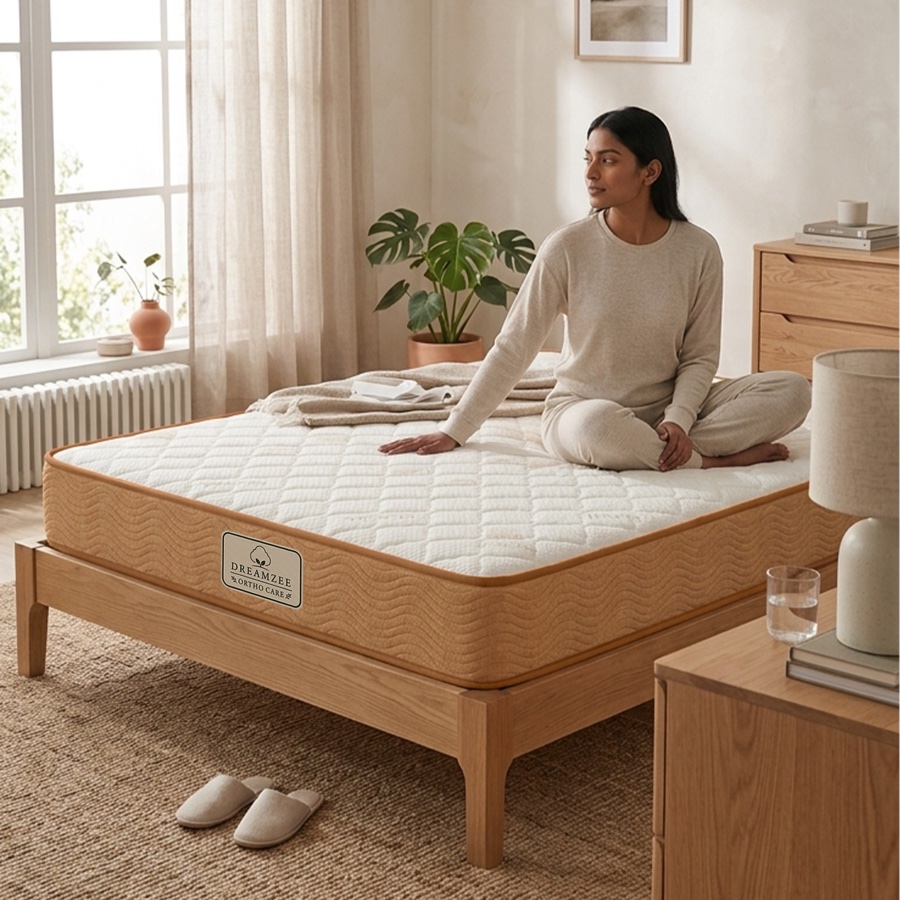
DreamCloud Premier takes the win for overall support and value, while Purple dominates in raw thermal dissipation.
DreamCloud Premier
14" Cashmere-Blend Hybrid | From $699
- Outstanding perimeter support (9.6/10) with reinforced coils
- Plush Euro-top cushion paired with zoned spinal alignment
- Industry-leading 365-night trial and Lifetime warranty
The Purple Mattress
9.25" GelFlex Grid / Polyfoam | From $799
- Instantly responsive hyper-elastic polymer grid
- Exceptional thermal dissipation via open-air channels
- Pinpoint pressure relief for hips and shoulders
Key Takeaways
- DreamCloud Premier provides a traditional plush pillow-top hybrid feel, winning on edge support (9.6/10) and warranty duration (Lifetime).
- Purple features the patented GelFlex Grid, yielding superior passive airflow (9.5/10 cooling) and immediate zero-lag pressure relief for side sleepers.
- Back sleepers and heavier individuals benefit from DreamCloud's robust 8.5-inch pocketed coil system and 14-inch total profile.
- Purple excels at contouring around sharp pressure points without the heat trap common to conventional memory foam.
| Spec / Lab Metric | DreamCloud Premier | Original Purple |
|---|---|---|
| Firmness Rating | 6.5 / 10 (Luxury Firm) | 6.5 / 10 (Medium-Firm Adaptive) |
| Mattress Profile | 14 inches | 9.25 inches |
| Core Construction | Coils + Memory Foam Euro-Top | 2" GelFlex Grid + Polyfoam Base |
| Edge Support Score | 9.6 / 10 | 8.5 / 10 |
| Cooling Score | 9.3 / 10 | 9.5 / 10 |
| Motion Isolation | 9.1 / 10 | 9.2 / 10 |
| Trial Period | 365 Nights | 100 Nights |
| Warranty | Lifetime | 10 Years |
| Starting Price | $699 | $799 |
Shopping for a new mattress frequently forces a choice between two completely different design philosophies. The standard DreamCloud and the upgraded DreamCloud Premier follow the classic luxury hybrid route: quilted cashmere blends, gel-infused memory foam, and heavy-gauge pocketed coils. In contrast, the original Purple bypasses traditional upholstery entirely, relying on a hyper-elastic polymer grid that flexes beneath high-load zones while holding its structure under broader surface contact.
At our sleep lab, we ran both mattresses through sensor-mat pressure mapping, thermal imaging, motion transfer accelerometers, and perimeter deflection tests. If you are struggling to resolve lower lumbar stiffness and seeking the best mattress for back pain, or simply deciding whether the GelFlex Grid feels too unusual for nightly sleep, the data clarifies exactly where each mattress excels.
Construction and Surface Feel
The DreamCloud Premier stands an imposing 14 inches tall. It starts with an airy cashmere-blend Euro-top quilted with two inches of plush memory foam, backed by a 2.5-inch transition layer of high-density polyfoam, an 8.5-inch pocketed coil unit, and a high-density base pad. The overall dynamic is undeniably upscale: you sink gently through the quilted crown, but the coils push back immediately to keep your lumbar spine level. It delivers a buoyant, "on-top-of-the-bed" hybrid feel that suits sleepers who appreciate classic hotel-style craftsmanship.
The Original Purple, measuring a modest 9.25 inches tall, delivers a distinct tactile sensation. Its upper comfort layer consists of a 2-inch hyper-elastic polymer GelFlex Grid surrounded by a firm foam boundary, resting on 7.25 inches of dual-layer polyurethane base foam. (If you prefer innersprings with your grid, the heavier Purple Hybrid provides that coil base, though at a steeper price point). Lying on the Purple feels like floating on a structured, rubbery matrix: the grid columns remain rigid under distributed weight, but instantly buckle and soften beneath your hips and shoulders. Sleepers moving from traditional viscoelastic foam—such as in our Purple vs Tempur-Pedic testing—often need three to four nights to adapt to this geometric rebound.
Pressure Relief and Spinal Alignment
During our 200-pound side-sleeper pressure map evaluations, the Original Purple produced impressive results around the acromion process (outer shoulder) and greater trochanter (hip bone). Because the polymer walls collapse only under concentrated pressure, the mattress eliminated hotspot peaks, registering under 26 mmHg across both areas. The material relieves pressure without wrapping the sleeper in dense, slow-response foam layers.
DreamCloud Premier logged similarly competitive pressure numbers, registering 28 mmHg at the hip and 27 mmHg at the shoulder. However, DreamCloud achieved this through progressive contouring. The memory foam Euro-top fills the lumbar gap completely, creating uniform surface contact along the lower back. For back sleepers between 130 and 240 pounds, DreamCloud provides more reliable sacral support. While lightweight side sleepers under 130 pounds might find Purple's 2-inch grid bottoms out into the firmer polyfoam base, average-to-heavy back sleepers will find DreamCloud's coil layer prevents pelvis sagging.
Motion Transfer and Couple Dynamics
Minimizing sleep disruption from a restless partner requires materials that absorb energy locally without resonating across the core. We test this by dropping a 20-pound kettlebell from 24 inches onto one side of the surface while monitoring seismograph sensors 12 inches away.
Both mattresses scored exceptionally well, each earning a spot on our shortlist for the best mattress for couples. The Original Purple isolates movement cleanly because its polymer columns flex independently; motion from one collapsed square does not transmit through the empty air pockets beside it (9.2/10). The DreamCloud Premier countered with a 9.1/10 score, dampening impact through thick memory foam quilting before residual kinetic shock reaches the individually wrapped innersprings. If you share a bed with an active tosser, neither option will disturb your sleep, though Purple's lack of internal coils makes it virtually silent under heavy repositioning.
Temperature Regulation: Polymer Grid vs. Hybrid Coils
Foam density and air movement govern overnight heat buildup. In our thermal retention trials, we place a heated thermal body pad on the surface for 60 minutes, remove it, and track heat dissipation over 15 minutes using an infrared camera.
Purple achieved one of the highest cooling ratings in our lab database (9.5/10). The GelFlex Grid is not a foam; it is an open-channel geometric structure composed of roughly 80% open air. Heat escapes outward through the sidewalls rather than trapping beneath the sleeper. Unlike the temperature sensitivities we noted in Purple vs Layla, Purple's grid retains its responsive elasticity regardless of ambient bedroom temperatures.
DreamCloud Premier is no slouch (9.3/10), outperforming nearly all all-foam beds thanks to the massive convective airflow running through its 8.5-inch pocketed coil cavity. However, its plush memory foam Euro-top inherently retains marginally more ambient warmth against the skin than Purple's open matrix. If you are an aggressive hot sleeper who wakes up sweating, Purple offers a distinct thermal advantage.
Edge Support and Real-World Durability
Edge support is where the DreamCloud Premier decisively pulls ahead. DreamCloud surrounds its coil core with heavy-duty perimeter coils, yielding just 3.2 inches of sinkage when sitting directly on the bed's edge. This provides a stable, reassuring perimeter whether you are tying your shoes or sleeping right up to the margin.
Purple's 9.25-inch build sinks 4.4 inches under identical perimeter edge-load tests. While Purple borders its polymer grid with firm polyurethane rails to stop edge collapse, sitting on the perimeter still feels spongy compared to DreamCloud's reinforced steel system. Additionally, DreamCloud's 14-inch total profile requires deeper bedding; make sure to check our deep-pocket fitted sheets guide before purchasing linens.
Regarding overall longevity, DreamCloud backs their mattress with an industry-leading 365-night trial and a Lifetime Warranty, whereas Purple includes an industry-standard 100-night trial and a 10-year warranty. We advise reading our breakdown on how to read a mattress warranty to verify what base foundations are required to keep both policies valid.
How They Compare to Market Rivals
If you prefer DreamCloud's traditional support but want a dual-coil system, review our Saatva vs DreamCloud comparison to see how innerspring stacks hold up. Alternatively, if you want targeted ergonomic zoning similar to Purple's hybrid lines, look at DreamCloud vs Helix. To see how these contenders rank across every category, explore our comprehensive guide to the best mattress 2026.
Which Mattress Should You Choose?
Choose DreamCloud Premier if:
- You want a tall, traditional luxury hybrid with a plush cashmere-blend pillow top.
- You sit on the edge of the bed frequently or sleep close to the edge and need maximum stability.
- You want the safety net of an entire year-long home sleep trial and lifetime warranty protection.
Choose the Original Purple if:
- You sleep hot and need active, passive airflow that bypasses heat-trapping foam altogether.
- You are a side sleeper who experiences painful pressure buildup at the hips and shoulders.
- You want an instantly responsive surface that enables quick positional adjustments without feeling stuck.
Frequently Asked Questions
Does the Purple mattress feel like a waterbed?
No. While the GelFlex Grid is flexible and rubbery to the touch, it behaves firmly until pinpoint pressure is applied. You rest evenly on top of the surface rather than sinking into a fluid, unstable mass.
Is DreamCloud Premier too firm for side sleepers?
At a calibrated 6.5/10 luxury-firm rating, most side sleepers over 130 pounds find the memory foam Euro-top provides ample contouring. However, petite side sleepers under 125 pounds might experience slight pressure buildup around the shoulder joints.
Do either of these mattresses require a box spring?
Neither requires a box spring. Both can be placed directly on a solid platform, an adjustable base, or a slatted frame with gaps no wider than 3 to 4 inches apart.

Jessica Moore, Certified Sleep Science Coach
Jessica has spent 8+ years analyzing biomechanics, pressure relief mapping, and mattress ergonomics. She leads our independent sleep lab in Austin, TX, overseeing thermal, motion, and durability testing.