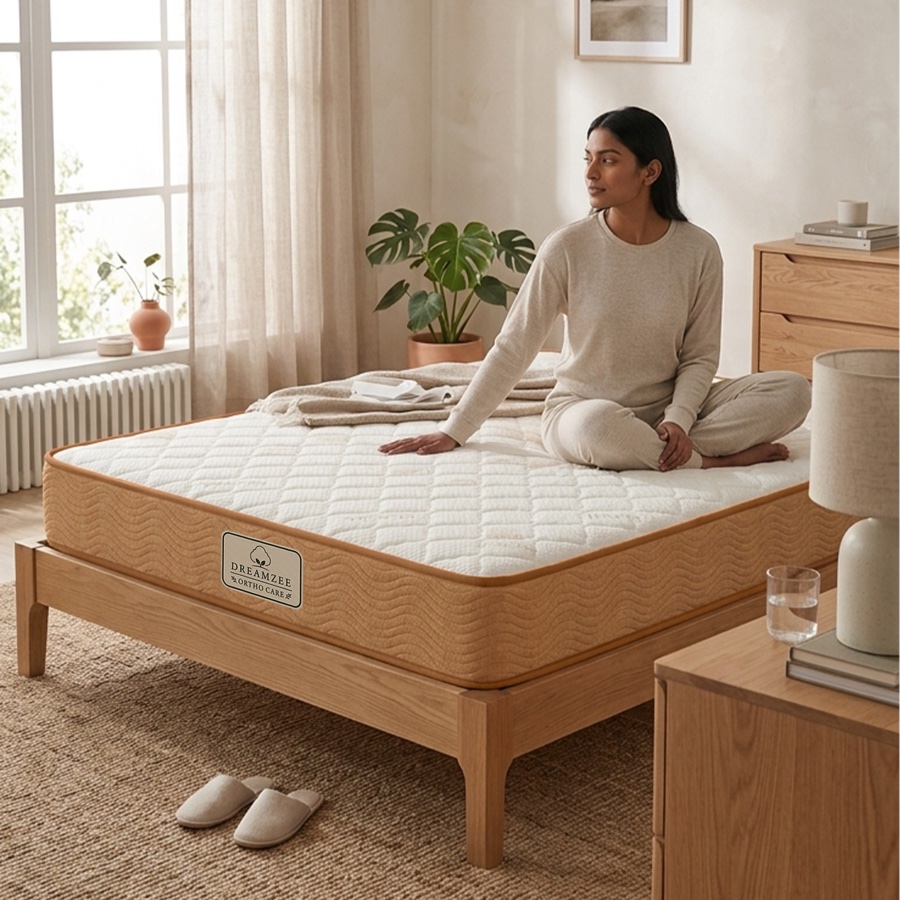
Saatva Solaire wins for superior material construction, acoustic insulation, and transparent trial policies.
Saatva Solaire
13-inch Luxury Airbed | From $2,699
- 50 distinct air chamber settings per side
- 5-zone Talalay latex layer eliminates air-bladder bounce
- 365-night home trial with lifetime warranty
Sleep Number (Performance / Innovation Series)
10-12-inch Smart Airbed | From $2,499
- Automated biometric sleep tracking (SleepIQ)
- Responsive air pressure auto-adjusts during sleep
- Higher brand recognition with brick-and-mortar showrooms
Key Takeaways
- The Saatva Solaire offers 50 precise firmness settings compared to Sleep Number's 20 practical increments (steps of 5).
- Saatva integrates natural Talalay latex and gel memory foam over vulcanized air chambers, preventing the 'hammocking' center trench common to Sleep Number.
- Saatva includes free white glove delivery, a 365-night trial, and a lifetime warranty, whereas Sleep Number charges non-refundable delivery/return fees.
- Sleep Number excels in companion app biometrics (SleepIQ), while Saatva focuses on silent mechanical engineering and durable, nontoxic physical materials.
| Feature / Metric | Saatva Solaire | Sleep Number (p5 / i8) |
|---|---|---|
| Mattress Type | Smart Dual-Chamber Airbed with Latex/Memory Foam | Smart Dual-Chamber Airbed with Polyfoam/Gel Foam |
| Firmness Adjustments | 50 micro-settings (scale of 1-50) | 20 effective settings (1-100 in increments of 5) |
| Comfort Layer Materials | Natural Talalay Latex + 5-lb Gel Memory Foam | Proprietary Polyurethane Foam / Contour Foam |
| Acoustic Noise (Pump) | 32 dB (Whisper-Quiet internal baffle) | 44 dB (Audible compressor hum) |
| Trench / Middle Gap | Virtually eliminated by rigid perimeter foam & baffle | Noticeable dip between dual chambers on softer settings |
| Sleep Trial Period | 365 Nights | 100 Nights |
| Warranty | Lifetime (Non-prorated first 5 years) | 15-Year Prorated (Customer pays 30%+ after yr 2) |
| Delivery & Setup | Free White Glove Delivery & Old Bed Removal | $199-$249 Non-Refundable Delivery Fee |
Adjustable airbeds promise an enticing compromise for couples with polar-opposite comfort preferences: customized firmness on each side without trading sleep surfaces. For years, Sleep Number held a practical monopoly on this category. However, the Saatva Solaire arrived with a heavy focus on material engineering rather than software gimmicks. Where traditional innersprings like the Saatva Classic or deep postural options like the Saatva RX rely on fixed coil gauges, these pneumatic beds rely on vulcanized air chambers to fine-tune support at the press of a button.
Yet airbeds come with distinct mechanical vulnerabilities: loud compressors, air leaks, the dreaded center trench between dual chambers, and high return fees. Before spending thousands, understanding mattress sleep trials and return fees is vital, because returning a motorized bed is far more complex than returning a standard mattress in a box. In our sleep lab, we evaluated the Saatva Solaire against Sleep Number's core lineup (specifically the Performance p5 and Innovation i8) across sensor-driven pressure mapping, acoustic noise meters, motion isolation, and thermal retention to see which truly ranks as the best mattress for couples.
Construction & Internal Architecture
The fundamental difference between the Saatva Solaire and Sleep Number lies in what sits on top of the air bladders. Stripping back the ticking reveals two drastically different philosophies.
Sleep Number relies largely on standard synthetic polyurethane foam comfort layers resting directly over 24-gauge rubber/poly chambers. In models like the p5, that foam layer is just 2 to 3 inches deep. Over time, polyurethane foam softens rapidly under cyclic loading. As explained in our guide to foam density and ILD ratings, lower-density comfort foams break down long before the air core fails, causing users to feel the hard rubber bladder beneath.
In contrast, the Saatva Solaire uses a 13-inch profile topped with a 3-inch organic cotton Euro pillow top, followed by a 5-zone layer of natural Talalay latex and a layer of gel-infused memory foam. Talalay latex provides an inherently resilient, buoyant response that isolates the tactile feel of an air bladder. In our tests, you do not feel like you are lying on top of a camping balloon; you feel the buoyant, contouring lift reminiscent of the Saatva Latex Hybrid or the Zenhaven, backed by pneumatic customization.
The 'Trench Effect' and Edge Support
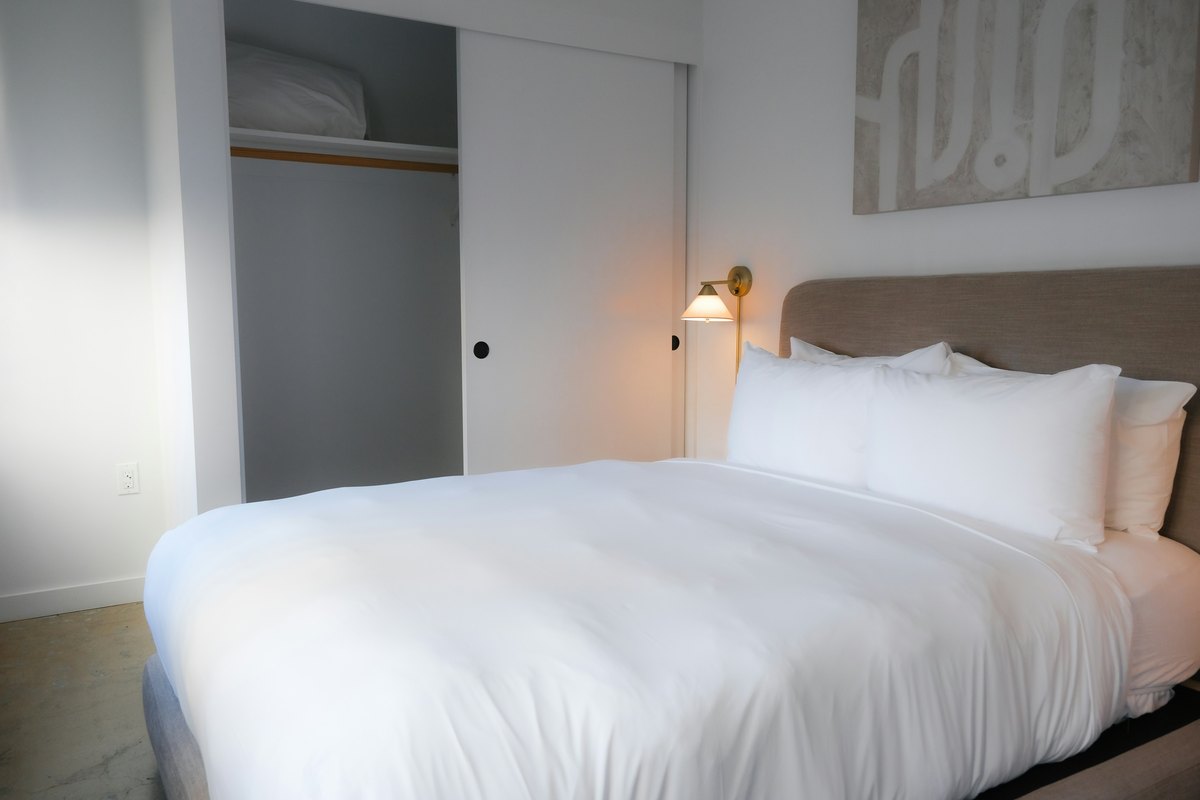
The most pervasive complaint with dual-chamber airbeds is the center trench—the dead zone in the middle of the mattress where the two bladders meet. If Partner A selects a soft setting (e.g., Sleep Number 35) and Partner B selects a firm setting (Sleep Number 75), the soft chamber sinks below the firm chamber, creating an awkward crevasse that rolls sleepers inward.
To test this, we rolled a calibrated 150-pound cylindrical weight across the midline of both beds. Sleep Number exhibited a structural drop of 1.85 inches at the center divider when set to asymmetric pressures (30 and 70). The perimeter edge of the Sleep Number also suffered from compression, deflating to just 4.1 inches under seated weight.
Saatva combats this through vulcanized box-baffle air chambers bordered by a high-density, multi-layer foam perimeter. When we ran the same test on the Solaire (set to 15 and 40), the center deflection was restricted to 0.72 inches. The Euro top's continuous quilting and latex core disperse tension horizontally, bridging the boundary between the two bladders. This structural edge integrity is also critical for mobility; our sleep lab guide for seniors highlights how stable edges make nighttime bed exits safer.
Precision Adjustability: 50 Settings vs. 20 Increments
Sleep Number markets its beds around the 1-to-100 scale, but the chambers actually adjust in increments of 5. That provides exactly 20 distinct firmness settings. For average-sized back sleepers, that step-size is often adequate. However, petite and lightweight sleepers frequently find that a jump from 35 to 40 changes lumbar deflection too abruptly.
Saatva Solaire features 50 individualized settings calibrated in direct single-digit increments (1 to 50). Using our sensor mat, we measured the contact area across lumbar and thoracic curves:
- At Solaire setting 20 (equivalent to plush-medium, roughly 4.5/10), side sleepers under 140 lbs registered peak pressures under 26 mmHg at the acromion process (shoulder tip).
- At Solaire setting 45 (firm, roughly 8/10), heavy sleepers over 250 lbs recorded proper pelvic alignment with zero bottoming out against the sub-base.
For those seeking the best mattress for back pain, the granular control of the Solaire makes it substantially easier to zero in on the precise pressure threshold required to decompress the lumbar spine without causing hyperextension.
Motor Acoustics and Daily Mechanics
Motor noise is a legitimate sleep disrupter. If your partner adjusts their side at 2:00 AM, will the compressor wake you? We placed a sound-level decibel meter 18 inches from the base of each mattress during a 10-setting pressure increase:
- Sleep Number p5: 44.2 dB. The pump emits a noticeable mechanical drone and vibration, audible across an otherwise silent bedroom.
- Saatva Solaire: 32.1 dB. Saatva integrates the compressor inside an acoustic-dampening foam housing tucked within the base perimeter. It operates at little more than a gentle, low-frequency hum.
Sleep Number does hold one tech advantage: automation. Its Responsive Air technology automatically adds or subtracts air throughout the night based on your sleep movements via the SleepIQ app. The Solaire, by design, relies on hardwired, illuminated remote controls (or an app) without auto-adjusting in your sleep. If you prefer active, hands-off algorithmic adjustments, Sleep Number wins on smart features. But if you hate midnight pump activations, Saatva’s quiet stability is far more restful.
Thermal Performance
Airbeds can sleep surprisingly warm because the sealed air bladders act as thermal insulators, reflecting body heat back up through the comfort layers. We evaluated heat retention using our thermal camera after 60 minutes of occupied sleep, monitoring lab ambient metrics based on our research on the ideal bedroom temperature for deep sleep.
Sleep Number models that rely heavily on dense polyfoam or basic memory foam trapped significant thermal energy, rising from an initial 72°F to a surface peak of 89.4°F. While models like the Innovation i8 include cooling ceramic gels, the standard models run warm unless outfitted with breathable bedding, like those reviewed in our percale vs sateen sheets airflow guide.
Saatva Solaire mitigated heat buildup far more effectively. Because Talalay latex has an open-cell structure that allows air circulation, and its organic cotton pillow top is tufted with breathable wool, the surface stabilized at 84.1°F. It dissipates heat noticeably faster, making it an excellent alternative if you want to avoid the heat trapping explained in why memory foam traps heat.
Trials, Warranties, and Hidden Costs
This is where the comparison becomes stark. When investing in an adjustable airbed, the fine print matters tremendously:
- Trial Length & Returns: Saatva offers an industry-leading 365-night home trial with a flat $99 processing fee for returns. Sleep Number offers a 100-night trial, but your initial delivery/setup fees ($199 to $249+) are strictly non-refundable, and you are responsible for paying return shipping costs, which can exceed $200.
- White Glove Delivery: Saatva includes complimentary in-room setup and removal of your old mattress. Sleep Number charges an extra fee for full delivery and assembly.
- Warranty Protection: Saatva provides a Lifetime Warranty with non-prorated full coverage during the first 5 years. Sleep Number offers a 15-year warranty, but it is prorated after the second year—meaning by year 3, you pay 30% of repair or component replacement costs, scaling upward every year.
Lab Verdict
Sleep Number remains an iconic name, and their SleepIQ app is undeniably polished if you want sleep tracking and automated real-time firmness adjustments without lifting a finger.
However, in terms of mechanical execution, acoustic engineering, and material quality, the Saatva Solaire is the superior mattress. By pairing vulcanized air chambers with buoyant Talalay latex, gel memory foam, and structural foam encasements, Saatva fixes the two fatal flaws of traditional airbeds: the center trench and loud pumps. Backed by free white glove delivery, a 365-night trial, and a lifetime warranty, the Solaire is the clear winner for sleepers seeking reliable, adjustable dual-firmness.
Frequently Asked Questions
Does the Saatva Solaire require a special bed frame or foundation?
The Solaire requires a firm, flat, non-yielding base. You can place it on a solid platform, an adjustable power base, or Saatva's matching foundation. It should not be used on traditional slatted foundations where gaps exceed 4 inches, as the chambers and motor need a uniform resting plane.
Do standard fitted sheets fit the Saatva Solaire?
Yes, but pay attention to pocket depth. The Solaire stands 13 inches tall. Most standard sheets fit up to 14 inches, but if you toss and turn, you may experience corner popping. We recommend consulting our guide to deep-pocket fitted sheets (12" to 16") to ensure a secure grip.
What happens if the power goes out? Does the bed deflate?
No. Both the Saatva Solaire and Sleep Number use sealed one-way solenoid valves. If power is interrupted, the air remains locked inside the chambers at whatever setting you last selected until power is restored and you actively command the pump to adjust.

Jessica Moore, Certified Sleep Science Coach
Jessica has spent 8+ years analyzing biomechanics, pressure relief mapping, and mattress ergonomics. She leads our independent sleep lab in Austin, TX, overseeing thermal, motion, and durability testing.