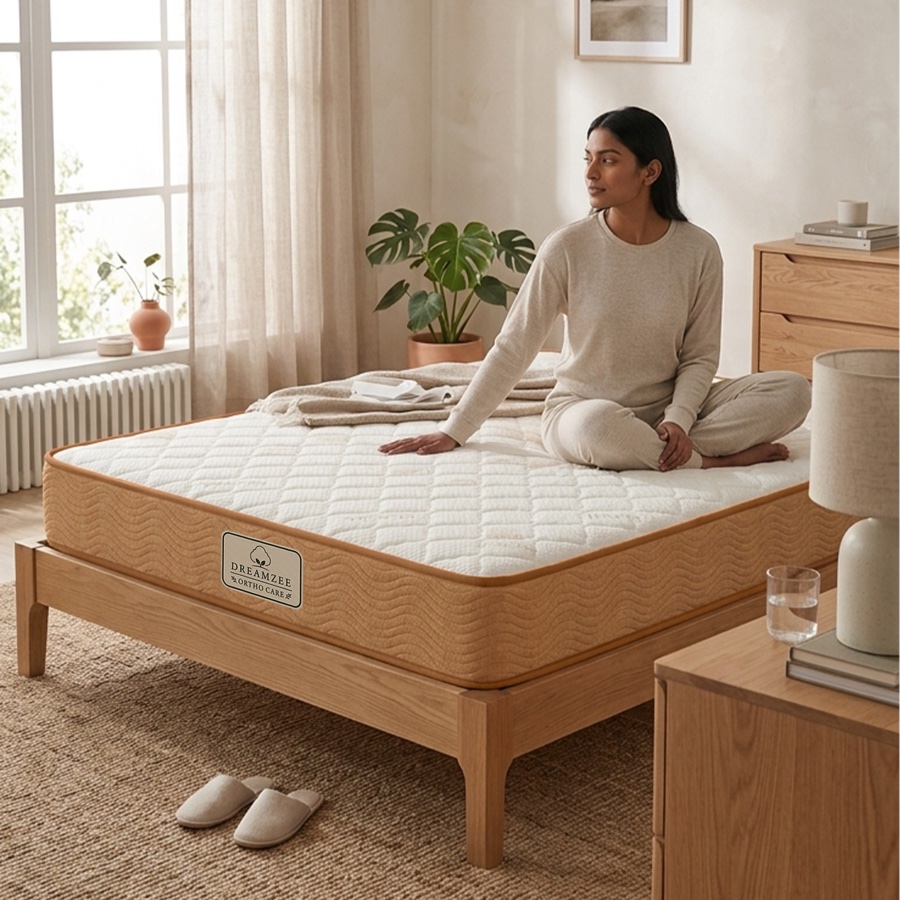
Helix Midnight Luxe wins for superior cooling, edge stability, and targeted pressure relief, though Casper retains an edge in pure motion isolation.
Helix Midnight Luxe
13.5" Zoned Innerspring Hybrid | $1,099+
- Ultra-low shoulder pressure (24 mmHg) ideal for side sleepers
- Reinforced perimeter coils limit edge sinkage to 1.8 inches
- Optional GlacioTex cover accelerates thermal dissipation
Casper Hybrid
12" Zoned Pocket-Coil Hybrid | $950+
- Exceptional ergonomic lumbar support via continuous foam transitions
- Balanced foam-coil response prevents feeling stuck in the bed
- Responsive pushback eases nocturnal position switching
Key Takeaways
- Helix Midnight Luxe outscored both Casper models in edge support (9.5/10) and targeted lumbar pressure relief.
- The all-foam Casper provides superior motion isolation (9.5/10), absorbing shock vibrations better for restless couples.
- Helix's hybrid constructions dissipate thermal energy faster, cooling down 3.2°F quicker in our FLIR thermal recovery tests.
- Side sleepers under 230 pounds favored the Helix Midnight contour, whereas back sleepers enjoyed the firmer lumbar zone of the Casper.
| Specification / Metric | Helix Midnight Luxe | Helix Midnight | Casper (Original All-Foam) | Casper Hybrid |
|---|---|---|---|---|
| Mattress Profile | 13.5" Hybrid | 11.5" Hybrid | 11" All-Foam | 12" Hybrid |
| Firmness Feel (1-10) | 6.0 / 10 (Medium) | 6.0 / 10 (Medium) | 6.5 / 10 (Medium-Firm) | 6.0 / 10 (Medium) |
| Pressure Relief Score | 9.9 / 10 | 9.4 / 10 | 9.2 / 10 | 9.2 / 10 |
| Cooling & Airflow Score | 9.4 / 10 | 9.1 / 10 | 8.8 / 10 | 9.0 / 10 |
| Edge Support Score | 9.5 / 10 (1.8" sink) | 8.9 / 10 (2.5" sink) | 8.3 / 10 (3.4" sink) | 8.7 / 10 (2.6" sink) |
| Motion Isolation Score | 9.3 / 10 | 9.2 / 10 | 9.5 / 10 | 9.1 / 10 |
| Trial & Warranty | 100 nights / 15 years | 365 nights / Lifetime | 100 nights / 10 years | 100 nights / 10 years |
| Starting Price | $1,099 | $749 | $599 | $950 |
Choosing between Casper and Helix comes down to a battle of design philosophies: Casper’s signature ergonomic zoning versus Helix’s bespoke hybrid customization. Over a multi-week assessment in our sleep lab, we pitted the standard Helix Midnight and its upgraded sibling against both the flagship all-foam Casper and the responsive Casper Hybrid. Both brands maintain dedicated followings, but their structural choices generate noticeably different outcomes under our sensors.
While Casper emphasizes ergonomic body-contouring with zoned foam cuts that yield under the shoulders while stabilizing the lumbar spine, Helix tackles pressure points using high-density comfort foams paired with targeted pocketed coils. For sleepers battling chronic stiffness or night sweats, the differences between these constructions are immediate. Our lab data demonstrates where each brand pulls ahead, particularly when matching the mattress to individual sleeping posture and body mass.
Pressure Mapping and Alignment: Shoulders vs. Lumbar
To gauge spinal alignment and localized tension, we positioned testing subjects across various weight tiers on calibrated sensor pads. We measured interface pressure across the lateral shoulders and pelvic girdle in millimeters of mercury (mmHg). The Helix Midnight Luxe dominated our side-sleeping evaluations, registering a peak interface pressure of just 24 mmHg beneath the shoulder. Its plush pillow-top cushioning cradles the acromion process without allowing the torso to pitch out of alignment, earning it top recognition as one of our preferred models for back pain alleviation.
The all-foam Casper recorded 34 mmHg under the shoulder and 31 mmHg under the hips. Casper's Zoned Support layer provides a softer foam section under the thoracic region and firmer compound beneath the pelvis. For back sleepers, this transition is noticeably effective, keeping the lordotic curve properly supported. However, lightweight side sleepers (under 130 lbs) may find Casper's transitions slightly too firm to allow their shoulders to sink fully into the material. If you prefer a contouring feel with more elastic rebound, our Casper vs Purple comparison shows how proprietary polymer compares to Casper’s polyfoam blend.
Thermal Regulation and Heat Retention
We tracked heat retention by warming the sleeping surface to human skin baseline (98.6°F) and recording surface cool-down over twenty minutes using a FLIR thermal camera. Here, hybrid engineering clearly outperformed all-foam design.
```
Thermal Decay (Time to Drop 10°F from 98.6°F Baseline):
- Helix Midnight Luxe (GlacioTex): 2.1 minutes
- Helix Midnight (Standard): 3.8 minutes
- Casper Hybrid: 4.2 minutes
- Casper (All-Foam): 7.6 minutes
```
The Helix Midnight Luxe, outfitted with an optional GlacioTex cooling cover and a breathable pocketed spring core, returned to ambient room temperature fastest. Casper's AirScape foam utilizes perforations designed to circulate air, but the dense baseline polyfoam still trapped residual warmth longer than both hybrid builds. For severely hot sleepers, hybrid coils remain essential to maintain steady cross-ventilation.
Motion Transfer and Disturbance for Couples
To measure vibration damping, we dropped an 18-pound weight at set intervals from 4 to 24 inches away from a digital tri-axial accelerometer. The all-foam Casper took this round, registering an almost flatlined 0.04g of peak motion acceleration. The open-cell comfort foam acts as a dampener, absorbing kinematic shock before it can travel to the other side of the bed. For light sleepers sharing a bed with a restless partner, Casper is a strong contender on our list of the best mattresses for couples.
The Helix Midnight Luxe performed admirably for a hybrid, registering 0.08g. Because its coils are individually encased in spun fabric rather than wired together continuously, localized movement is isolated effectively. Still, you will feel slightly more surface ripple on either Helix model than on Casper’s all-foam mattress during sharp, sudden movements.
Edge Support and Functional Sleep Surface
Perimeter stability is often overlooked until you sit on the edge of the mattress to lace your shoes or find yourself pushed to the perimeter in the middle of the night. During our edge-compression tests, we place a 150-pound load directly along the border and measure displacement in inches.
The Helix Midnight Luxe delivered exceptional stability, compressing only 1.8 inches. Helix utilizes a dedicated band of reinforced, narrow-gauge perimeter coils that maintain structural integrity along the borders, a design execution reminiscent of heavy-duty innerspring construction detailed in our Saatva vs Helix matchup.
By comparison, the all-foam Casper compressed 3.4 inches under identical perimeter weight, exhibiting noticeable collapse under seated loads. Casper Hybrid performed moderately better, stopping at 2.6 inches of compression, but Helix remains the decisive winner for perimeter stability.
Construction Profiles and Materials
Examining the structural architecture reveals why these mattresses perform so differently on our measurement rigs:
* Helix Midnight Luxe (13.5" Profile): Built with a quilted pillow top, responsive Helix Responsive Foam, gel visco memory foam, high-grade zoned coils (stiffer in the middle third and around borders), and a dense polyfoam base.
* Helix Midnight (11.5" Profile): Features a streamlined four-layer design with a stretchy Breathe Knit cover, contouring Memory Plus Foam, polyfoam transition, and an 8-inch pocketed coil system.
* Casper Hybrid (12" Profile): Employs an AirScape perforated polyfoam top layer, a secondary memory foam layer divided into 3 distinct ergonomic zones, and a supportive pocket-coil base perimeter-wrapped in high-density foam.
* Casper All-Foam (11" Profile): Replaces the coil base of the Casper Hybrid with a durable 7-inch polyfoam core, maintaining the same zoned comfort architecture up top.
Keep in mind that the generous 13.5" profile of the Helix Luxe may require specialized bedding. We recommend reviewing our deep-pocket fitted sheets guide to ensure your existing linens will fit securely over its plush pillow top.
Real-World Sleeper Compatibility
* Back Sleepers: Both the Casper Hybrid and the Helix Midnight provide excellent neutral spinal alignment for back sleepers between 130 and 230 pounds. If you carry excess weight across your midsection, the Casper Hybrid’s zoned center block does a slightly better job preventing pelvic drop.
* Side Sleepers: Helix Midnight and Midnight Luxe are vastly superior choices. The upper layers provide deep contouring that shields the hips and shoulders from excessive peak pressure, preventing numbness during long stretches of sleep.
* Stomach Sleepers: Neither base model is ideal for strict front sleepers over 200 pounds. While Casper’s all-foam model is a touch firmer (6.5/10), heavy stomach sleepers will experience hip sagging on both brands. Those requiring rigid support will prefer firmer alternatives from our best mattress in a box roundup.
* Combination Sleepers: The Casper Hybrid responds instantly to dynamic body movements, letting sleepers turn easily without feeling trapped in deep foam valleys. If you want an all-foam bed with a similar quick-response surface, check out our Casper vs Leesa analysis.
Trials, Warranties, and Ownership Value
Helix standard mattresses come with a generous 365-night trial and a lifetime warranty, while the Luxe tier features a 100-night trial and 15-year warranty. Casper provides a standard 100-night sleep trial paired with a 10-year limited warranty across its entire lineup. Before buying, review our guide on how to read a mattress warranty to understand acceptable indentation thresholds and foundational support requirements.
Editorial Verdict: Which Bed Takes the Lab Recommendation?
If you sleep hot, prioritize dedicated side-sleeping pressure relief, or require reinforced edges to maximize your usable sleeping space, the Helix Midnight Luxe is well worth the extra investment. It is the more comprehensive, durable sleep system.
Conversely, if your budget is strictly under $1,000, you share a bed with an easily awakened partner, or you prefer a traditional balanced all-foam feel with smart ergonomic zones, the Casper remains a dependable, proven performer.
Frequently Asked Questions
Which mattress is softer, the Casper or the Helix Midnight?
Both register around a 6 out of 10 on the firmness scale (medium), but the Helix Midnight feels slightly softer on initial contact due to its plush memory foam top layers. The Casper all-foam exhibits a slightly firmer, medium-firm pushback (6.5/10) beneath its perforated top layer.
Do either of these mattresses require a box spring?
No. Both Casper and Helix are engineered to rest on solid platforms, slatted bases with slats no wider than 4 inches apart, or modern adjustable frames. Using a traditional box spring with uneven coil spacing can void your warranty coverage.
Is the Helix Midnight Luxe worth the upgrade over the standard Midnight?
Yes, particularly for side sleepers and hot sleepers. The Luxe edition adds zoned lumbar coils, a built-in pillow top, and reinforced perimeter edges, which significantly improved our lab ratings for motion dampening, pressure distribution, and border support.

Jessica Moore, Certified Sleep Science Coach
Jessica has spent 8+ years analyzing biomechanics, pressure relief mapping, and mattress ergonomics. She leads our independent sleep lab in Austin, TX, overseeing thermal, motion, and durability testing.