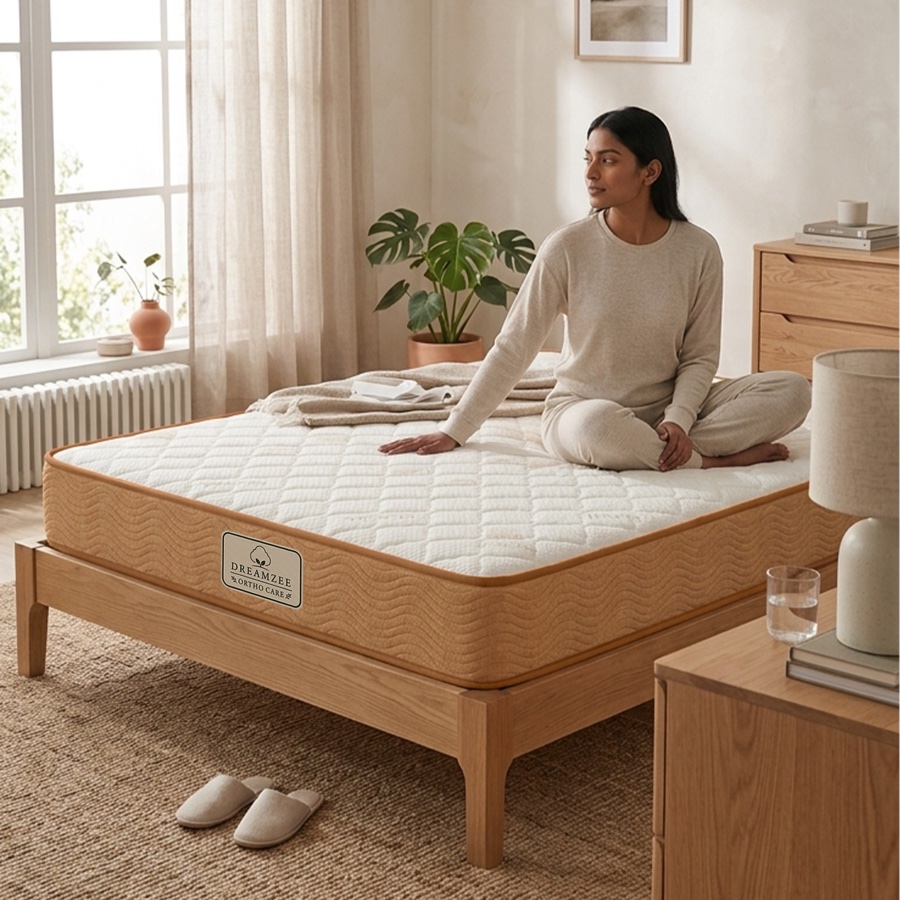
Saatva Classic wins on spinal alignment, edge strength, and tailored firmness options, while DreamCloud takes value for plush pressure relief.
Saatva Classic
11.5" or 14.5" Dual-Coil Hybrid | Starting at $1,095
- Exceptional 9.9/10 edge support via high-density foam encasement
- Active spinal wire provides superior lumbar lift for lower back pain
- Three distinct firmness feels (Plush Soft, Luxury Firm, Firm)
DreamCloud
12" Cashmere-Blend Hybrid | Starting at $499
- Significantly more accessible pricing for budget-conscious shoppers
- Thicker memory foam contouring cradles prominent pressure points
- Strong baseline hybrid airflow through pocketed support coils
Key Takeaways
- Saatva Classic features an authentic dual-coil construction with dedicated lumbar active wire support, excelling for back pain and edge security.
- DreamCloud provides a deeper memory foam sink and quilted cashmere top at a significantly lower entry price point.
- Saatva arrives uncompressed with free White Glove Delivery, whereas DreamCloud ships roll-packed in a box.
- Both brands back their mattresses with a 365-night home trial and a lifetime warranty, though return processing fees differ.
| Metric / Feature | Saatva Classic | DreamCloud Hybrid |
|---|---|---|
| Overall Lab Score | 9.8 / 10 | 9.3 / 10 |
| Mattress Construction | Dual-Coil Innerspring (Bonnell Base + Pocket Coils) | Memory Foam & Pocketed Coil Hybrid |
| Firmness Options | Plush Soft (3), Luxury Firm (6.5), Firm (8) | Luxury Firm Single Feel (6.5) |
| Perimeter Edge Support | 9.9 / 10 (Foam encasement) | 8.9 / 10 (Perimeter coil reinforcement) |
| Motion Isolation | 9.2 / 10 | 9.1 / 10 |
| Cooling Performance | 9.8 / 10 | 9.0 / 10 |
| Delivery Method | Free White Glove Delivery (Uncompressed) | Bed-in-a-Box (Roll-packed) |
| Trial & Warranty | 365 Nights / Lifetime ($99 return fee) | 365 Nights / Lifetime (Free returns) |
| Starting Price (Twin / Queen) | $1,095 / $1,995 | $499 / $999 |
Choosing between Saatva and DreamCloud comes down to whether you prefer an authentic, dual-coil innerspring with active spinal uplift or a plush, memory-foam-forward hybrid. The Saatva Classic is engineered with dual steel coil systems and an active lumbar wire, earning our top rating for posture maintenance. In contrast, the standard DreamCloud brings cashmere-quilted memory foam over pocketed springs at a remarkably lower entry barrier, competing closely with alternatives like the DreamCloud Premier.
Both beds target sleepers seeking hotel-grade luxury, but their underlying mechanics yield drastically different sensations. While Saatva focuses on buoyant surface response and perimeter stability—similar to the durability profiles we analyze when contrasting Saatva vs Beautyrest or Saatva vs WinkBeds—DreamCloud relies on visco-elastic foam to soften joint impact before meeting pocketed coils. Understanding how their internal layouts affect spinal biomechanics, heat distribution, and long-term durability will dictate the right investment for your sleep position.
Construction and Lab Teardown
When we dissect the Saatva Classic in the sleep lab, its dual-spring architecture stands out. The foundation consists of 13-gauge recycled steel hourglass coils that provide a rigid, virtually indestructible structural base. Above that sits a layer of 14.5-gauge individually wrapped pocket coils that contour dynamically to hips and shoulders. An active 14-gauge center-support wire reinforces the central third of the mattress, directly beneath a dense layer of high-density memory foam. The perimeter is fortified with high-density polyfoam rails, wrapped in an organic cotton cover treated with botanical antimicrobial protection. Because it is never compressed into a box, the internal metal tempered coils never endure packaging strain.
DreamCloud takes a more traditional direct-to-consumer hybrid approach. The cover blends synthetic cashmere and polyester, quilted directly into 1.5 inches of high-density gel memory foam and 1 inch of transition foam. Below this plush pillow-top rests an 8.5-inch pocketed coil unit with reinforced perimeter edges, followed by a 1-inch high-density polyfoam base. While DreamCloud offers deep initial contouring, it arrives vacuum-sealed. Understanding how long does a mattress in a box take to expand is critical here, as the foams require 24 to 48 hours to shed off-gassing odors and reach true geometric firmness.
Firmness, Spinal Alignment, and Pressure Relief
Saatva offers three distinct firmness profiles: Plush Soft (rated 3/10 on our firmness scale), Luxury Firm (6.5/10), and Firm (8/10). Our sleep lab evaluations center primarily on the flagship Luxury Firm, which delivers crisp floating support. During sensor mat analysis, back sleepers registered under 24 mmHg of pressure across the lumbar region, thanks to the targeted center wire lifting the sacrum into natural alignment. For sleepers with chronic spinal tension, the mechanics echo our dedicated clinical findings for the Saatva RX, placing it consistently among our selections for the best mattress for back pain.
DreamCloud is sold in a single "Luxury Firm" configuration, which our sensors rate as a true 6.5/10. However, the surface feel is noticeably softer than Saatva's Luxury Firm due to the initial 2.5 inches of quilted foam. Side sleepers weighing between 130 and 230 pounds registered excellent pressure mitigation at the acromion process (shoulder point) and greater trochanter (hip bone). While lighter side sleepers find DreamCloud easier on the joints, strict stomach sleepers above 200 pounds experienced slight hyperextension of the lumbar spine as the pelvis sank past the transition foam.
Thermal Regulation and Edge Support
Temperature regulation testing revealed an advantage for Saatva. Utilizing a thermal imaging camera across a 60-minute sleep session, Saatva's surface temperature increased by only 1.2°F before stabilizing. Because its core consists predominantly of open air circulating through two distinct coil tiers, heat escapes rapidly through the breathable organic cotton cover. DreamCloud demonstrated solid cooling for an all-foam top layer, rising 2.8°F, but the dense gel memory foam inevitably retains more radiant heat than bare coils and cotton.
Perimeter stability is where the gap widens significantly. Saatva scored a near-perfect 9.9/10 in our edge compression protocol. When our 200-pound tester sat on the edge of the Saatva Classic, the perimeter compressed just 1.75 inches due to the dedicated high-density foam encasement. Sitting on the edge of DreamCloud produced 3.2 inches of displacement. For couples sharing a queen mattress or individuals who use the mattress edge to assist in getting out of bed, Saatva offers superior structural integrity, competing with the heavy-duty builds we explore in Saatva vs Helix.
Motion Transfer and Intimacy
To measure motion isolation, we drop a 15-pound bowling ball from a height of 24 inches onto one side of the bed while reading an accelerometer 18 inches away on the opposite side. DreamCloud performed well, registering an amplitude transfer of just 1.1 m/s², as its thick memory foam layers absorb surface energy efficiently. This makes it a compelling, affordable option for light sleepers seeking the best mattress for couples.
Saatva Classic recorded a slightly higher 1.6 m/s² of motion transfer. While the upper pocketed coils absorb local movement, the underlying Bonnell coil base transmits subtle kinetic vibration across the chassis. What you trade in motion isolation, however, you gain in responsiveness. Saatva's energetic pushback makes repositioning effortless, avoiding the quicksand feel common in high-density visco-elastic designs like those seen in our Saatva vs Tempur-Pedic evaluation.
Trials, Warranties, and Long-Term Value
Both manufacturers provide an industry-leading 365-night sleep trial alongside a lifetime warranty. Yet the fine print contains practical differences outlined in our guide on understanding mattress sleep trials and return fees. Saatva charges a flat $99 transportation fee to cover the logistics of picking up an uncompressed mattress, whereas DreamCloud facilitates returns with zero out-of-pocket penalty.
Similarly, protecting your investment requires adherence to strict foundation standards; we recommend reading how to read a mattress warranty to verify that your slat spacing prevents center sagging. To preserve structural balance, follow our brand-by-brand maintenance schedule by rotating either bed 180 degrees every six months.
Final Verdict: Which Should You Choose?
Choose the Saatva Classic if you experience lower back discomfort, prioritize maximum edge seating stability, sleep hot, or prefer white-glove setup over unboxing compressed foam yourself. Its three firmness variations make it adaptable across all body profiles, holding a rightful spot on our list of the best mattress 2026.
Choose the DreamCloud if you want the pressure-cradling hug of high-grade memory foam on a disciplined budget. It provides exceptional hybrid value, especially for back and side sleepers under 220 pounds who value cushioned joint relief and zero-dollar return policies.
Frequently Asked Questions
Is Saatva worth the price difference over DreamCloud?
Yes, for sleepers who require reinforced lumbar support, maximum edge rigidity, and uncompressed delivery. Saatva's dual-coil platform and tailored firmness choices justify the extra investment for long-term spinal health. However, if your primary goal is pressure relief on side joints, DreamCloud delivers 90% of the luxury feel at nearly half the entry cost.
Which mattress is firmer: Saatva Luxury Firm or DreamCloud?
While both rate around a 6.5/10, Saatva Luxury Firm feels slightly firmer in daily use due to its surface spring tension and lumbar wire. DreamCloud's 2.5-inch quilted foam pillow-top allows your hips and shoulders to sink deeper before engaging the pocketed coils.
Do either of these mattresses require special deep-pocket sheets?
Saatva comes in an 11.5-inch or 14.5-inch profile, while DreamCloud stands at 12 inches. If you select the 14.5-inch Saatva Classic, you will need deep-pocket fitted bedding. Consult our deep-pocket fitted sheets guide to ensure your linens fit securely without slipping.
Jessica Moore, Certified Sleep Science Coach
Jessica has spent 8+ years analyzing biomechanics, pressure relief mapping, and mattress ergonomics. She leads our independent sleep lab in Austin, TX, overseeing thermal, motion, and durability testing.