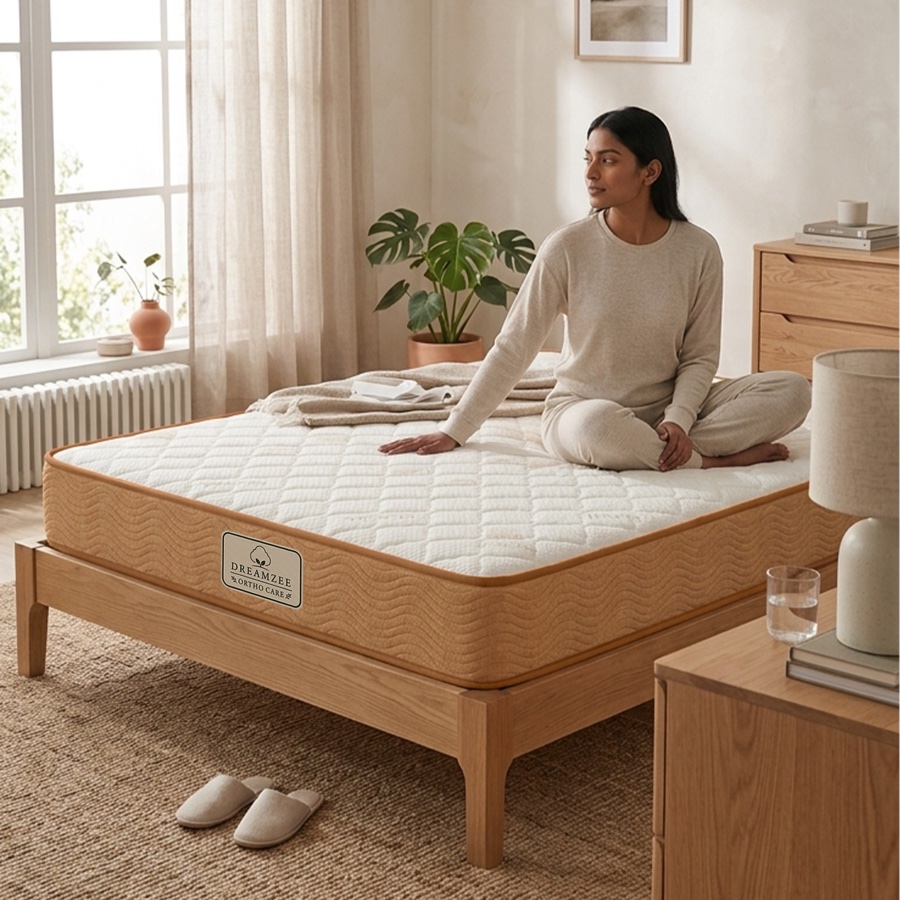
Saatva Classic wins for back support, cooling, and durability; Casper wins for motion deadening and value.
Saatva Classic
Dual-Coil Hybrid | Starting at $1,095
- Dual-coil system provides exceptional spinal alignment and airflow
- High-density foam encasement yields class-leading 9.9 edge support
- 365-night home trial backed by an unconditional lifetime warranty
Casper Original
All-Foam Zoned Mattress | Starting at $599
- Zoned Support softer beneath shoulders, firmer beneath lumbar
- Dense polyfoam layers deaden motion transfer for restless partners
- Accessible price point makes quality contouring affordable
Key Takeaways
- Saatva Classic outperforms Casper in edge support (9.9 vs 8.3) and breathability due to its dual-coil steel structure.
- Casper Original dampens motion transfer better, absorbing partner movement through its dense all-foam core.
- Saatva offers three distinct firmness levels and two heights with free in-room delivery, whereas Casper is a compressed bed-in-a-box.
- Casper costs significantly less at starting price ($599 vs $1,095), but Saatva provides a lifetime warranty and a 365-night trial.
| Lab Metric / Feature | Saatva Classic | Casper Original |
|---|---|---|
| Mattress Category | Dual-Coil Luxury Hybrid | Zoned All-Foam |
| Overall Score | 9.8 / 10 | 9.2 / 10 |
| Firmness Choices | Plush Soft (3), Luxury Firm (6.5), Firm (8) | Medium-Firm (6.5 / 10) |
| Profile Height | 11.5" or 14.5" | 11" |
| Edge Deflection (50 lb load) | 2.6 inches (Outstanding) | 4.1 inches (Moderate) |
| Thermal Dissipation Rate | Return to baseline in 1.8 mins | Return to baseline in 3.6 mins |
| Peak Lumbar Interface Pressure | 18.4 mmHg (Back sleeper) | 23.1 mmHg (Back sleeper) |
| Trial & Warranty | 365 Nights / Lifetime Warranty | 100 Nights / 10-Year Limited |
| Queen MSRP | $2,095 | $1,295 |
Evaluating the Saatva Classic against the flagship Casper brings you face-to-face with the two dominant design philosophies in modern sleep ergonomics: a luxury dual-coil innerspring hybrid versus a compressed all-foam bed. Both beds have shaped the online mattress space, but they address spinal support, thermoregulation, and pressure dispersion from opposite engineering directions.
While Casper made its reputation as a premier best mattress in a box engineered to balance pressure relief with ease of delivery, Saatva sidesteps boxed compression entirely, shipping flat with white-glove setup. In our biomechanical sleep lab tests, both mattresses met high structural standards, yet their performance profiles diverge significantly—particularly for sleepers seeking targeted pain relief or active lumbar reinforcement. If you struggle with lower spine stiffness, identifying the best mattress for back pain requires examining how their support cores respond to direct load.
Construction and Core Architecture
The Casper Original uses a three-layer foam construction measuring 11 inches tall. The top comfort layer is Casper’s proprietary AirScape open-cell polyurethane foam, engineered with perforations to encourage heat dissipation. Beneath lies Casper's Zoned Support layer, a distinct memory foam tier split into three ergonomic sections: softer under the shoulder girdle to allow proper sinkage and firmer beneath the lumbar and pelvic region to prevent spinal sagging. The foundation is a durable polyurethane base foam that stabilizes the entire stack. For sleepers who want coil bounce from Casper, the brand also manufactures the Casper Hybrid, which swaps that dense base foam for pocketed springs.
By contrast, the Saatva Classic is an 11.5-inch or 14.5-inch dual-coil luxury innerspring topped with a 3-inch Euro pillow top quilted in organic cotton. Beneath the Euro pillow top rests a thin layer of high-density memory foam positioned strictly beneath the lumbar region. Directly below this sits a comfort layer of 416 individually wrapped pocket coils (14.5-gauge) that articulate independently around your hips and shoulders. The lower tier consists of a rugged innerspring unit with 416 tempered steel 13-gauge open coils surrounded by high-density foam edge encasement rails. Saatva also utilizes specialized active-coil engineering in models like the Saatva RX, but even their flagship Classic features patented active wire reinforcement across the center third.
Lab Pressure Relief and Spinal Alignment
To measure pressure relief, we position lightweight (125 lb), average (165 lb), and heavyweight (230 lb) testers onto a calibrated sensor pad containing over 1,600 sensors calibrated to detect interface pressure in millimeters of mercury (mmHg). Readings under 30 mmHg indicate a low risk of capillary occlusion and numbness.
On the Casper Original, side sleepers under 200 pounds saw exceptional pressure dispersion. The Zoned Support layer allowed the broad lateral surface of the shoulder to compress 2.8 inches into the comfort foam, recording a low peak pressure of 21.2 mmHg at the acromion process. Back sleepers under 180 pounds maintained neutral lordotic curvature with no noticeable hyperextension. However, our 230-pound tester experienced pelvic sinkage beyond the optimal neutral plane, reading 34.6 mmHg near the sacrum due to compression fatigue of the base foam.
The Saatva Classic (tested in its most popular "Luxury Firm" configuration, rated 6.5/10) produced a flatter, more buoyant posture. Back sleepers across every weight class recorded outstanding spinal alignment. The center-third lumbar active wire prevented the pelvis from dipping, keeping lumbar interface pressure at an ultra-low 18.4 mmHg. Side sleepers who weigh under 135 pounds, however, registered slight resistance at the hip joint (29.8 mmHg), as the tempered coils do not yield as gently as Casper’s open-cell foam. Lighter side sleepers will prefer Saatva’s "Plush Soft" variant.
Motion Transfer and Responsiveness
Motion isolation is critical for couples sharing a bed. We test this metric using an industrial accelerometer paired with a 10-pound drop ball dropped from heights of 12 and 24 inches. We record the peak acceleration on the partner’s side of the mattress in meters per second squared (m/s²).
The Casper Original proved significantly better at deadening kinetic energy. The drop impact registered a minor 0.42 m/s² disturbance 18 inches away from the impact zone, with vibrations settling within 0.35 seconds. The combination of open-cell comfort foam and dense transitional foam absorbs kinetic ripples before they travel across the mattress, performing similarly to competitors examined in our Casper vs Helix analysis.
The Saatva Classic, featuring two distinct tiers of steel springs, is naturally springier. Our accelerometer recorded 1.34 m/s² of motion transfer, taking 0.82 seconds to stabilize. While the top pocketed coils do isolate motion far better than vintage open-coil beds, the underlying 13-gauge hourglass coils transmit energy across the lower frame. Restless sleepers who wake at the slightest movement will favor Casper's dampening qualities, whereas combination sleepers who change positions frequently will love Saatva’s effortless bounce.
Thermoregulation and Edge Support
Overheating is a common complaint with all-foam mattresses. To test temperature regulation, our team uses a FLIR thermal imaging camera to track how quickly the mattress surface cools down after a tester lies on it for 30 minutes at a stabilized 72°F ambient room temperature.
Casper's AirScape foam contains thousands of micro-perforations that circulate air better than traditional memory foam. However, because it is still an all-foam mattress, it trap body heat within its comfort layer. The Casper surface took 3.6 minutes to return to room temperature. The Saatva Classic outperformed it decisively: its massive internal dual-coil chamber provides unrestricted convection airflow. Combined with a breathable organic cotton cover and natural thistle flame barrier, the Saatva dissipated heat rapidly, returning to baseline in just 1.8 minutes. In thermal tests, the Saatva matches high-airflow beds like those in our Saatva vs DreamCloud matchups.
Edge support was another clean victory for Saatva. In our edge deflection test, we seat a 200-pound tester on the edge of the mattress and measure vertical compression. Casper compressed 4.1 inches, creating noticeable roll-off sensation when sitting or sleeping near the edge. Saatva’s Dual-Edge encasement compressed only 2.6 inches, providing a firm, stable boundary that maximizes usable sleep surface.
Logistics, Unboxing, and Trials
Casper ships vacuum-sealed in a cardboard box. Unboxing requires slicing the plastic wrap and letting the foams expand. For detailed timelines on room airing and expansion, read our guide on how long a mattress in a box takes to expand. Casper provides a standard 100-night trial and a 10-year limited warranty.
Saatva eliminates unboxing entirely by offering free White Glove delivery. Couriers bring the uncompressed mattress into your room, place it on your base, and remove your old mattress at no charge. Saatva provides a full 365-night sleep trial and a lifetime warranty, though they charge a $99 processing fee on returns. Be sure to review our breakdown of mattress sleep trials and hidden return fees to avoid surprises.
The Final Verdict: Which Should You Buy?
Choose the Saatva Classic if you want traditional innerspring support, superior cooling airflow, rigid edge stability, and multiple firmness options. It is especially suited for back sleepers, stomach sleepers, and individuals weighing over 200 pounds who need long-term lumbar support.
Choose the Casper Original if you prefer a modern contouring feel with zero motion transfer, sleep primarily on your side, and want a lightweight, budget-friendly bed-in-a-box backed by reliable ergonomic zoning.
Frequently Asked Questions
Does Casper smell when unboxed?
Yes, Casper produces a mild polyurethane off-gassing scent upon initial unboxing due to its vacuum packaging. The odor typically dissipates within 24 to 72 hours in a well-ventilated room. Saatva is never wrapped in plastic boxes and has virtually no chemical off-gassing.
Can you flip either mattress?
Neither the Casper Original nor the Saatva Classic is flippable. Both are constructed with dedicated top-down comfort stacks and support cores. However, you should rotate both mattresses head-to-toe 180 degrees every six months to ensure even wear.
Which mattress lasts longer?
The Saatva Classic generally lasts longer—between 9 and 12 years—due to its dual tempered-steel coil construction and dense perimeter encasement. All-foam models like the Casper Original typically have an operational lifespan of 6 to 8 years before experiencing subtle foam degradation in the hip area.

Jessica Moore, Certified Sleep Science Coach
Jessica has spent 8+ years analyzing biomechanics, pressure relief mapping, and mattress ergonomics. She leads our independent sleep lab in Austin, TX, overseeing thermal, motion, and durability testing.