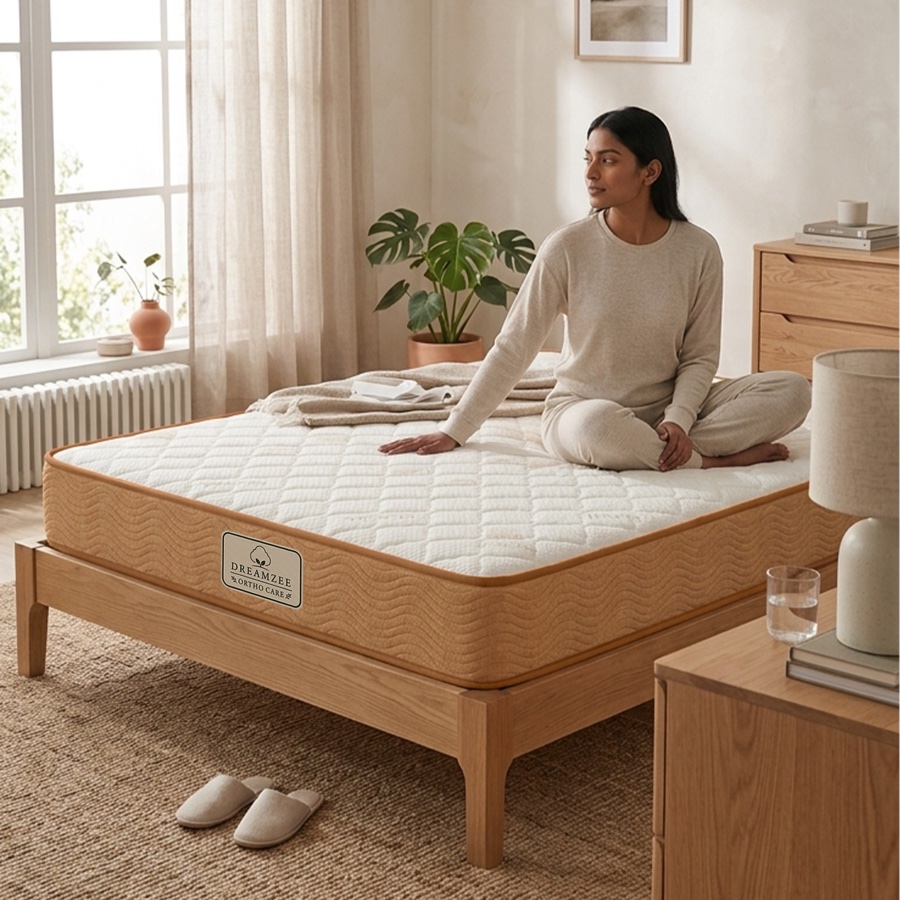
Helix Midnight Luxe edges out DreamCloud for side sleepers, while DreamCloud wins on value and trial length.
Helix Midnight Luxe
13.5" Zoned Hybrid, Starting at $1099
- Targeted lumbar zone prevents hip sinkage while cushioning shoulders
- Exceptional 9.9/10 pressure-relief mapping for strict side sleepers
- Tencel or GlacioTex cooling cover options for hot sleepers
DreamCloud Premier
14" Cashmere Hybrid, Starting at $699
- Robust 365-night home sleep trial with lifetime warranty backing
- Euro-top construction cushions pressure points without excessive sink
- Reinforced perimeter coils deliver top-tier 9.6/10 edge support
Key Takeaways
- Helix Midnight Luxe dominates side sleeping with dedicated zoned lumbar coils and superior contouring around the hips and shoulders.
- DreamCloud delivers a firmer, floating feel with a thicker cashmere-blend cover, excelling for back and combination sleepers.
- DreamCloud offers an industry-leading 365-night trial and lifetime warranty, compared to Helix's standard 100-night window.
- Helix provides broader customization options across its wider lineup, while DreamCloud prioritizes heavy-gauge perimeter support.
| Metric / Feature | DreamCloud (Standard) | DreamCloud Premier | Helix Midnight (Standard) | Helix Midnight Luxe |
|---|---|---|---|---|
| Mattress Type | Pocketed Coil Hybrid | Cashmere-Blend Hybrid | Pocket Coil Hybrid | Zoned Innerspring Hybrid |
| Tested Firmness | 6.5 / 10 (Luxury Firm) | 6.5 / 10 (Luxury Firm) | 6.0 / 10 (Medium) | 6.0 / 10 (Medium) |
| Total Profile Height | 12 inches | 14 inches | 11.5 inches | 13.5 inches |
| Pressure Relief Score | 9.2 / 10 | 9.5 / 10 | 9.4 / 10 | 9.9 / 10 |
| Edge Support Score | 8.9 / 10 | 9.6 / 10 | 8.9 / 10 | 9.5 / 10 |
| Cooling Score | 9.0 / 10 | 9.3 / 10 | 9.1 / 10 | 9.4 / 10 |
| Sleep Trial Period | 365 nights | 365 nights | 100 nights | 100 nights |
| Warranty | Lifetime | Lifetime | 10-15 Years | 15 Years |
| Starting Price | $499 | $699 | $749 | $1099 |
Choosing between online hybrid giants often boils down to a fundamental engineering question: do you prefer a buoyant, luxury-firm surface that keeps your torso lifted, or targeted, zoned contouring designed to cradle angular joints? When testing the DreamCloud against the Helix Midnight, our lab sensors registered stark differences in feel, spinal alignment, and structural resistance.
Both manufacturers rely on hybrid architecture, pairing individual pocketed coils with multi-layer foams to balance support with surface comfort. However, their execution addresses completely different sleeping ergonomics. If you have weighed other cross-brand evaluations like Casper vs Helix or Saatva vs DreamCloud, you know that small variations in coil gauge and quilt batting yield profoundly different sleep postures. In this head-to-head comparison, we unpack real data from our pressure mapping sensors, motion isolation rigs, and perimeter load testing.
Construction and Lab Teardown
The standard DreamCloud is built on a 12-inch profile featuring an integrated quilted Euro-top. Its top layer utilizes gel-infused memory foam quilted directly into a cashmere-blend cover. Beneath this plush initial contact layer rests dynamic transition foam that prevents sleepers from contacting the 8.5-inch pocketed steel coil unit prematurely. Moving up the line, the DreamCloud Premier beefs this profile to 14 inches by adding a secondary high-density memory foam layer, yielding an ultra-plush introductory surface before engaging firm pushback.
Helix approaches hybrid engineering through targeted biomechanics. The standard Helix Midnight features an 11.5-inch stack starting with a breathable cover, followed by Memory Plus Foam and dynamic polyfoam above hundreds of individually wrapped coils. The flagship upgrade, the Helix Midnight Luxe, thickens the profile to 13.5 inches and adds an ultra-dense pillow top alongside zoned pocketed coils. In our lab teardown, these zoned coils demonstrated distinctly stiffer tension through the center third of the bed, specifically calibrated to arrest hip sag.
Firmness, Feel, and Pressure Mapping
On our standardized 1-to-10 firmness scale—where 10 is concrete—the DreamCloud models sit at a true 6.5 (Luxury Firm). The immediate sensation is one of elevated buoyancy. The quilted cashmere exterior compresses just enough to soften bony protrusions, but the dense transition foam immediately initiates upward support. It creates an on-the-mattress sensation rather than an in-the-mattress sink, making it a reliable pick among the best firm mattress contenders in the hybrid class.
By contrast, the Helix Midnight sits at a balanced 6.0 (Medium), while the Midnight Luxe pairs a 6.0 rating with significantly more localized sinkage. During pressure-mat trials using 140-pound and 210-pound side sleepers, the Helix Midnight Luxe earned a near-perfect 9.9/10 pressure-relief score. Peak stress zones at the shoulder and greater trochanter (hip bone) registered in the low-pressure blue-and-green spectrum. On DreamCloud, side sleepers over 200 pounds registered slight yellow hotspots around the deltoids, indicating that its denser transition foam does not yield quite as readily to side-oriented joints.
For back and stomach sleepers, however, DreamCloud’s firmness profile keeps the lumbar curve neutrally aligned without hyper-extension. If you frequently browse matchups like Nectar vs DreamCloud or DreamCloud vs DreamCloud Premier, you understand how critical that baseline support is for spine stability.
Motion Transfer and Edge Support
Couples who wake up whenever a partner shifts positions need strong motion deadening. To test this, we dropped a 15-pound kettlebell from 36 inches onto one side of the mattress while capturing seismic vibration curves via accelerometers placed 18 inches away.
- DreamCloud: Transferred nominal secondary reverberation. The heavy steel coils are individually encased, meaning energy dissipates across adjacent pockets without dominoing across the core. Score: 9.1/10.
- Helix Midnight Luxe: Scored an impressive 9.3/10. Its plush pillow top absorbed the initial drop energy before mechanical shock waves could reach the spring system. It consistently lands high on our index of the best mattress for couples.
Edge stability, crucial for sitting on the perimeter or utilizing the entire mattress surface, tilted in favor of the upgraded DreamCloud builds. In our perimeter compression test, applying 200 pounds along the outer edge resulted in just 3.1 inches of sinkage on the DreamCloud Premier, earning a 9.6/10. The Helix Midnight Luxe held firm at 3.3 inches of compression (9.5/10), thanks to reinforced perimeter coils along its length.
Temperature Regulation and Airflow
Trapping heat inside dense foams is the most common grievance sleepers report with hybrid designs. Because both mattress designs feature tall, un-baffled coil bases, airflow through the interior remains robust, facilitating consistent thermal dissipation.
Our heat retention tests utilize digital thermocouple probes placed beneath a heated thermal blanket replicating human skin temperature (98.6°F). After removing the heat source, the Helix Midnight Luxe—fitted with its optional phase-change GlacioTex cover—cooled down to ambient room temperature within 11 minutes. The DreamCloud’s cashmere blend required roughly 14 minutes, which is still respectable compared to all-foam beds. If you run exceptionally warm, the specialized GlacioTex cover gives Helix a decisive edge.
Trial Periods, Warranties, and Value
DreamCloud’s commercial terms remain among the most generous in the direct-to-consumer bedding space. Every DreamCloud mattress includes a 365-night sleep trial and an unlimited lifetime warranty. As covered in our guide on how to read a mattress warranty, lifetime coverage provides long-term peace of mind, provided you maintain an unyielding, supportive foundation.
Helix backs the standard Midnight with a 100-night trial and a 10-year warranty, bumping the Midnight Luxe to a 15-year warranty. Before initiating a return with either brand, be sure to review our overview of understanding mattress sleep trials to account for required 30-night break-in windows.
DreamCloud also holds a distinct price advantage, frequently selling its flagship queen well below the standard Helix Midnight, while the feature-dense Helix Midnight Luxe commands an investment exceeding $1,000.
Final Verdict: Which Should You Choose?
Select the DreamCloud if:
- You are a back sleeper, combination sleeper, or lightweight stomach sleeper who benefits from an elevated, buoyant 6.5/10 support plane.
- You want maximum long-term purchasing security with an unconditional 365-night trial and lifetime warranty.
- You are shopping under a stricter budget and want hotel-style Euro-top comfort without premium markups.
- You prefer a bed with low sinkage that allows you to change sleeping positions effortlessly.
Select the Helix Midnight Luxe if:
- You are a strict side sleeper who experiences morning hip tightness or shoulder numbness on firmer mattresses.
- You need zoned ergonomic back support; its reinforced center third cradles your lumbar while leaving pressure points free of tension.
- You want customizable temperature defense via the optional GlacioTex cooling fabric top.
- You prefer the deep, contouring sink of a high-end pillow-top hybrid.
Frequently Asked Questions
Is DreamCloud or Helix better for chronic lower back pain?
For sleepers suffering from alignment-related discomfort, the Helix Midnight Luxe usually outperforms because of its zoned coil matrix, which provides firmer pushback beneath the pelvis. However, back sleepers seeking a flat, level surface may find the DreamCloud equally effective. For broader clinical considerations, reference our curated guide to the best mattress for back pain.
Do these mattresses require deep-pocket sheets?
Yes, particularly the upgraded versions. The DreamCloud Premier measures 14 inches tall, and the Helix Midnight Luxe measures 13.5 inches. Both require bedding designed for high-profile mattresses to prevent sheet corners from snapping off during the night. Consult our deep-pocket fitted sheets guide to confirm accurate corner dimensions.
How long do these hybrids take to off-gas after unboxing?
Both models ship compressed inside plastic wraps. While usable within a few hours, structural foams take roughly 24 to 48 hours to regain full buoyancy and shed harmless factory scents. Read our breakdown on how long a mattress in a box takes to expand for acceleration tactics.

Jessica Moore, Certified Sleep Science Coach
Jessica has spent 8+ years analyzing biomechanics, pressure relief mapping, and mattress ergonomics. She leads our independent sleep lab in Austin, TX, overseeing thermal, motion, and durability testing.