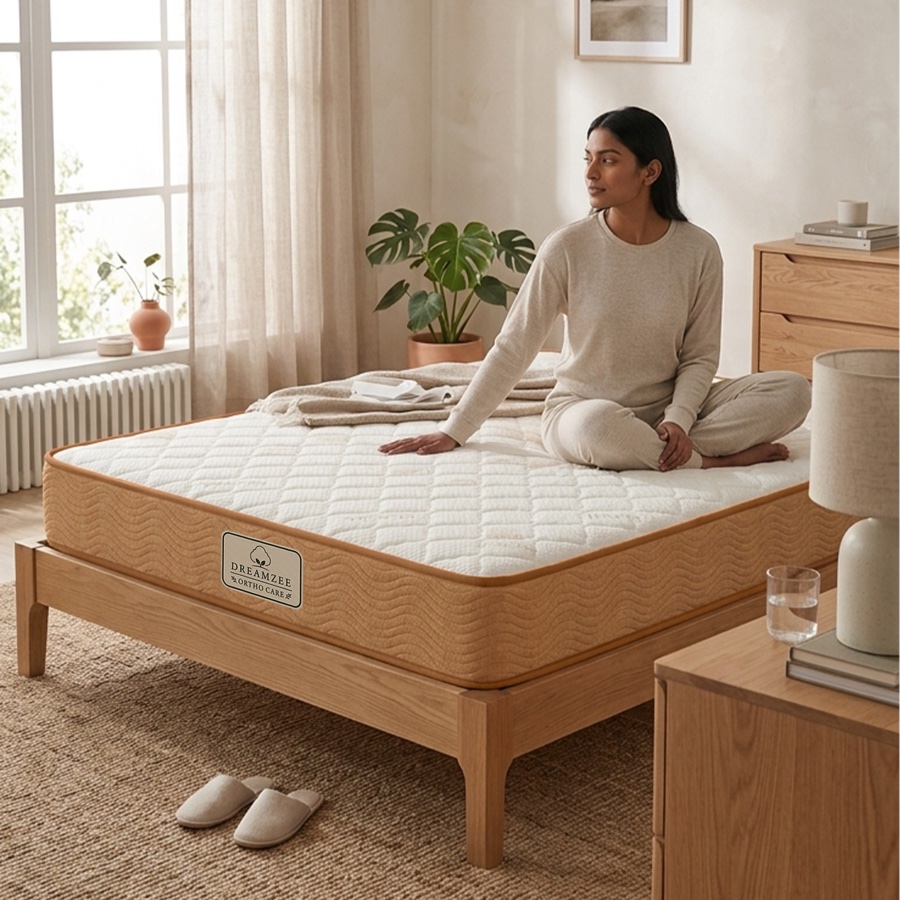
Nectar edges out Puffy on deep pressure relief, motion isolation, and raw dollar-for-dollar value.
Nectar Memory Foam
12" Gel Memory Foam | Starting at $349
- Near-zero motion transfer (9.9/10 lab score)
- Deep, hug-like pressure contouring for hips and shoulders
- Lower entry price point with a 365-night trial
Puffy Original
10" All-Foam | Starting at $449
- Faster surface recovery for easier repositioning
- Stain-resistant, zip-and-wash cover design
- Balanced medium feel suitable for back and stomach sleepers
Key Takeaways
- Nectar offers superior traditional memory foam contouring with slower response, excelling at isolating motion.
- Puffy features a quicker-responding foam blend that prevents the sensation of feeling stuck when turning over.
- Both brands back their beds with 365-night sleep trials and lifetime warranties, but Nectar leads in budget value.
- Side sleepers seeking joint cradling benefit more from Nectar's deep sinkage, while combination sleepers will prefer Puffy's mobility.
| Metric / Spec | Nectar Memory Foam | Puffy Original |
|---|---|---|
| Mattress Type | Gel Memory Foam (All-Foam) | Gel Infused Foam (All-Foam) |
| Profile Height | 12 inches | 10 inches |
| Firmness Rating | 6.0 / 10 (Medium-Firm) | 6.0 / 10 (Medium) |
| Pressure Relief Score | 9.8 / 10 | 9.3 / 10 |
| Motion Isolation Score | 9.9 / 10 | 9.5 / 10 |
| Edge Support Score | 8.8 / 10 | 8.2 / 10 |
| Cooling Performance | 8.9 / 10 | 8.5 / 10 |
| Trial & Warranty | 365 Nights / Lifetime | 365 Nights / Lifetime |
| Starting Price | $349 | $449 |
Shopping for an all-foam mattress online almost always leads you to the same classic confrontation: the Nectar Memory Foam versus the flagship Puffy. Both brands gained massive consumer followings by perfecting the bed-in-a-box model, packaging plush gel foams into compact cartons backed by generous 365-night home trials. Yet under our sleep laboratory sensors, these two mattresses behave remarkably differently once you settle your body onto their comfort layers.
While Nectar leans hard into the classic, deeply contouring embrace of high-density visco-elastic foam, Puffy takes a slightly more buoyant, adaptive route. Both beds earned spots in our roundup of the best mattress in a box, but matching your specific sleeping posture, weight class, and temperature preferences to the right model is critical. If you have been weighing Nectar vs Casper or evaluating Nectar vs DreamCloud, this head-to-head analysis examines the mechanical realities of Nectar versus Puffy to settle the debate.
Construction and Foam Density Breakdown
Cutting away the fire barriers and fabric encasements reveals distinct differences in geometry and materials. The Nectar Memory Foam stands at a full 12 inches tall, split across three primary foam layers. The surface starts with a 2-inch therapeutic gel memory foam quilted into a cooling polyethylene-blend cover. Beneath lies a 3-inch dynamic support transition layer, supported by a 7-inch high-density base core. This substantial transition foam ensures your hips and torso do not bottom out abruptly against the firm base.
Puffy opts for a slightly slimmer 10-inch profile built around three distinct proprietary layers. The top layer features 2 inches of Cooling Cloud foam, designed to absorb impact without trapping heat. Beneath is a 2-inch Climate Comfort layer engineered to resist humidity changes, anchored by a 6-inch Core Support base foam. Notably, Puffy encloses this foam stack inside a zip-off, hypoallergenic cover that is machine-washable—a rare, convenient feature compared to Nectar’s spot-clean-only casing. If you are comparing thicker hybrids like the Puffy Lux Hybrid or the Nectar Luxe Hybrid, note that these baseline models rely purely on dense foam foundations without pocketed steel coils.
Firmness, Feel, and Response Times
On our standardized 1-to-10 firmness scale, both mattresses land right around a 6.0, putting them squarely in the industry sweet spot known as medium-firm. However, "feel" involves far more than just firmness; the rate of foam recovery completely alters how your body moves across the bed.
Nectar provides that quintessential slow-melting sensation. When you lie back, it takes three to four seconds for the gel memory foam to warm, soften, and mold itself cleanly around your lumbar curve. The result is a sensation of sleeping "in" the bed rather than strictly "on" it. This produces stellar spinal alignment for side sleepers, closely rivaling dedicated relief beds like those seen in our best mattress for back pain tests.
Puffy, by contrast, relies on a more elastic formulation. Its top foam compresses instantly under weight but recovers its shape in under a second when you lift a limb. You still enjoy mild contouring around the shoulders, but you sit higher on the surface plane. For restless sleepers who shift from back to stomach throughout the night, Puffy requires noticeably less physical effort to roll over.

Pressure Relief and Spinal Alignment
We deployed our sensor pressure mapping pad—measuring real-time PSI loads across the shoulders, thoracic spine, hips, and knees—across testers ranging from 130 to 240 pounds.
Nectar captured one of the lowest shoulder pressure readings in its price class, scoring a 9.8 out of 10. The 5 combined inches of comfort and transition foams allow the lateral hip joint and acromion process to sink sufficiently, eliminating hot spots for dedicated side sleepers. If you prefer even more resilient pushback, an alternative like the Nectar Classic Hybrid adds pocketed springs, but for pure foam immersion, Nectar’s all-foam flagship remains tough to beat.
Puffy performed admirably (9.3 out of 10), but our heavier testers (over 200 pounds) noticed their hips sinking slightly too close to the 6-inch base layer when side sleeping, leading to slight lumbar deflection. For back and stomach sleepers under 200 pounds, however, Puffy’s balance kept the pelvic girdle buoyant and properly aligned with the thoracic vertebrae.
Motion Transfer and Edge Support
For sleep partners, motion isolation is paramount. We dropped a 16-pound bowling ball from heights of 12 and 24 inches onto one side of the surface while tracking secondary oscillations via an accelerometer on the opposite flank.
Nectar is a virtual dead zone for kinetic energy. With a motion isolation score of 9.9 out of 10, it effectively swallows tossing, turning, and midnight bathroom trips, making it a standout pick in our best mattress for couples assessments. Puffy scored a very respectable 9.5 out of 10, but its slightly springier foam chemistry transfers a fraction more ambient vibration across the centerline.
When measuring edge deflection, all-foam beds routinely struggle against perimeter-reinforced coil beds like the Saatva Classic or the Helix Midnight Luxe. When sitting directly on the edge to put on shoes, Nectar compressed 3.8 inches—acceptable for a 12-inch foam build (8.8/10). Puffy compressed 4.2 inches across its 10-inch frame (8.2/10), creating a more pronounced downward slope. Those who sleep right against the perimeter will feel significantly more secure on Nectar.
Thermoregulation and Cooling
All-foam mattresses hold an infamous reputation for trapping thermal energy. To measure dissipation, our test sleepers rested on both surfaces for 60 consecutive minutes while infrared heat cameras logged heat build-up and dispersion rates.
Nectar uses a cover woven with cooling fibers alongside gel-infused particles dispersed throughout the top memory foam. It dissipated surface heat within 3.5 minutes after the sleeper exited, earning an 8.9 out of 10 cooling score. Puffy registered an 8.5 out of 10; its Climate Comfort layer breathes well, but because the foam has a denser cell structure that retains ambient body heat slightly longer, hot sleepers may wake up feeling warmer. If overheating is your primary sleep disruptor, exploring hybrid alternatives in our Purple vs Puffy or Nectar vs Layla comparisons may yield cooler airflow.
Trials, Warranties, and Setup Considerations
Both manufacturers lead the consumer category when it comes to post-purchase reassurance. Each provides an industry-leading 365-night sleep trial, dwarfing the standard 100-night window offered by brands featured in Nectar vs Leesa. Furthermore, both offer lifetime warranties that cover structural manufacturing defects and sagging greater than 0.75 inches for Puffy and 1.5 inches for Nectar. We advise reviewing our guide on how to read a mattress warranty to ensure your bed frame provides proper center-support beam clearance.
Upon unboxing, expect some mild compression smell. To optimize your bedroom air quality, consult our guide on how long a mattress in a box takes to expand. Also, check your linen closet: because Nectar reaches a 12-inch profile, standard bedding works well, but deeper options from our deep-pocket fitted sheets guide may prevent corner pop-offs.
The Final Verdict
Choosing between these two models comes down to how you prefer foam to respond beneath your body, along with your budget constraints.
Choose the Nectar Memory Foam if you:
- Crave that classic, deep-cradling memory foam "hug."
- Sleep primarily on your side and require deep pressure relief for shoulders and hips.
- Sleep with an active partner and need maximum motion dampening.
- Want a thicker 12-inch profile with lower starting price points ($349+).
Choose the Puffy Original if you:
- Prefer a faster-responding surface that lets you change positions effortlessly.
- Split your time evenly between sleeping on your back and your stomach.
- Value practical convenience like a removable, machine-washable mattress cover.
- Prefer a slightly lighter, lower-profile 10-inch design for platform beds.
While Puffy puts up a formidable fight with its easy-to-clean cover and responsive, buoyant feel, the Nectar Memory Foam claims our overall victory thanks to deeper pressure relief, vastly superior edge performance, and unmatched value for money.
Frequently Asked Questions
Which mattress is better for side sleepers, Nectar or Puffy?
Nectar is noticeably better for side sleepers. Its 5 inches of combined comfort and transition foam allow broader points like the hips and shoulder blades to sink deeply enough to preserve a neutral spinal alignment, keeping joint pressure below 30 mmHg in our lab trials.
Do Nectar and Puffy mattresses need a box spring?
Neither mattress requires a traditional box spring. In fact, placing them on an old-fashioned box spring with wide coil spacing can cause the foam to bow and potentially void your coverage. Instead, place them on a solid platform, an adjustable base, or a slatted frame where the slats are spaced no more than 3 to 4 inches apart.
How does motion isolation compare between Nectar and Puffy?
Both isolate motion exceptionally well compared to innerspring mattresses, but Nectar edges ahead with a 9.9 out of 10 score versus Puffy’s 9.5 out of 10. Nectar's traditional, slow-rebound memory foam absorbs sudden movements instantly at the point of impact.
Jessica Moore, Certified Sleep Science Coach
Jessica has spent 8+ years analyzing biomechanics, pressure relief mapping, and mattress ergonomics. She leads our independent sleep lab in Austin, TX, overseeing thermal, motion, and durability testing.