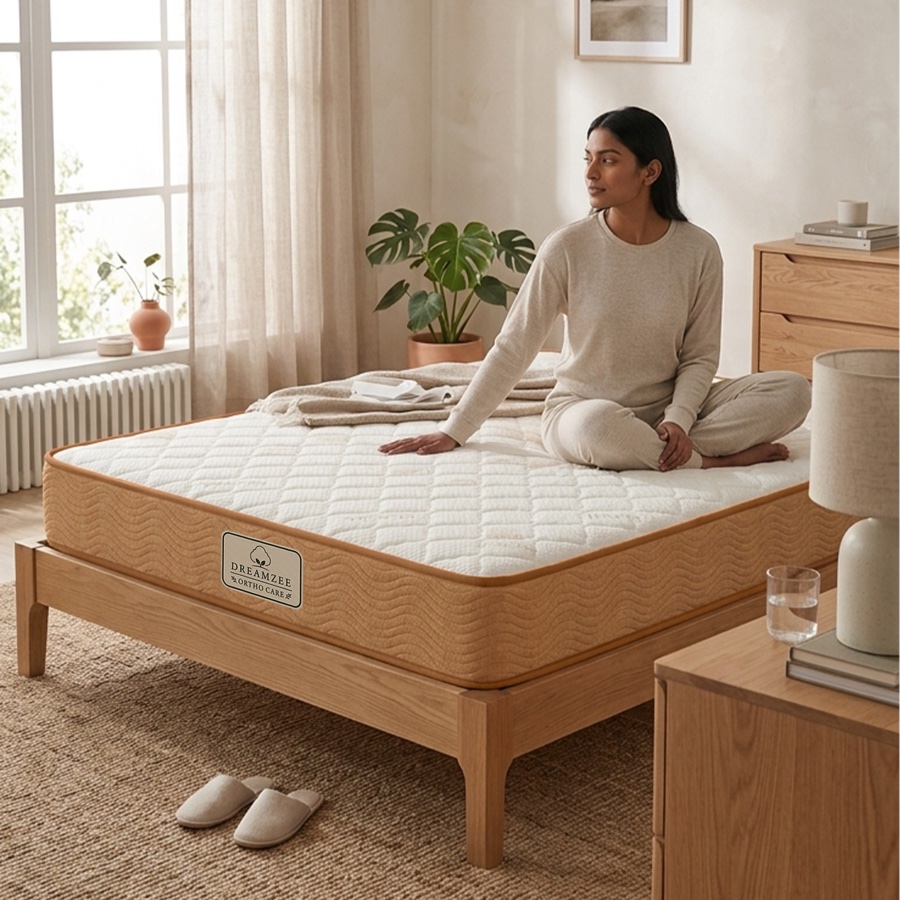
Layla edges ahead for side sleepers seeking contouring versatility, while Casper wins on targeted lumbar alignment.
Layla Memory Foam
10.5" Flippable Dual-Sided Foam, Starts at $599
- Two firmness options in one mattress (4.5/10 and 7.5/10)
- Superior localized pressure relief on shoulders and hips
- Generous lifetime warranty and 120-night trial
Casper Original
11" Zoned Ergonomic Foam, Starts at $599
- Dedicated Zoned Support keeps lumbar spine elevated
- Easier surface repositioning for combination sleepers
- Balanced medium-firm feel universally suited to back sleepers
Key Takeaways
- Layla features a flippable construction offering two distinct feels: Medium-Soft (4.5/10) and Firm (7.5/10).
- The flagship all-foam Casper uses Zoned Support that reinforces the lumbar region while cradling the shoulders at a true Medium-Firm (6.5/10).
- Layla's copper-gel memory foam edges out Casper for deep contouring, making it a standout pick among the best soft mattress contenders.
- Casper provides a faster-responding surface that simplifies position shifts, whereas Layla excels in pure motion dampening.
| Specification / Metric | Casper (Original All-Foam) | Layla (Memory Foam) |
|---|---|---|
| Mattress Profile | 11 inches | 10.5 inches |
| Construction Style | 3-layer all-foam with ergonomic zoning | Flippable 4-layer dual-sided foam |
| Firmness Rating | Medium-Firm (6.5 / 10) | Soft Side: 4.5 / 10 | Firm Side: 7.5 / 10 |
| Pressure Relief Score | 9.2 / 10 | 9.5 / 10 |
| Motion Isolation Score | 9.5 / 10 | 9.6 / 10 |
| Edge Support Score | 8.3 / 10 | 8.2 / 10 |
| Cooling Performance | 8.8 / 10 | 8.8 / 10 |
| Sleep Trial & Warranty | 100 nights / 10-year warranty | 120 nights / Lifetime warranty |
| Starting Price | $599 | $599 |
The bed-in-a-box industry owes much of its modern architecture to Casper and Layla. When buyers evaluate the direct-to-consumer space, the Casper all-foam model and the dual-sided Layla stand out as two of the most heavily scrutinized options on the market. Both launch at an accessible entry price of $599, but their core design philosophies diverge sharply when placed on our testing apparatus.
Casper relies on ergonomic zoning to enforce neutral spinal curvature, an engineering strategy that has earned it top billing among the best mattress for back pain. In contrast, Layla approaches spinal support by giving sleepers two distinct firmness feels inside a single flippable shell. If you find yourself torn between these legacy brands—or weighing them against rivals like Casper vs Helix or Casper vs Leesa—our biomechanical analysis breaks down where each layer excels.
Construction and Material Breakdown
Stripping off the zippered covers reveals fundamentally different construction approaches. Casper stands 11 inches tall and features three distinct foam layers. The comfort deck consists of Casper's proprietary AirScape open-cell polyfoam, perforated with small aeration channels to encourage convective air circulation. Directly beneath sits the Zoned Support layer. This transition segment uses softer foam beneath the shoulders to permit lateral sinking, alongside higher-density foam under the lower back and hips to prevent pelvic sagging. The foundation is a durable, high-density polyfoam base.
Layla measures 10.5 inches in total height, engineered symmetrically around a 4-inch core of dense support polyfoam. Because Layla is fully flippable, it features two working sleeping surfaces. The Medium-Soft side uses 3 inches of 3.5 lb/cu.ft copper-gel-infused memory foam backed by 2 inches of channeled surface-modification foam for targeted airflow and relief. Flipping the mattress over reveals the Firm side, structured with 1 inch of the same copper-gel foam over the shared support core. The cover is woven with a thermo-conductive yarn designed to draw heat away on contact.
Firmness, Feel, and Ergonomics
On our standardized 1-to-10 firmness scale, where 10 represents solid floorboard rigidity, the Casper registers at a true 6.5/10 Medium-Firm. Because of its zoning, however, the sensation changes depending on body placement. Under the thoracic spine and shoulders, the feel softens to roughly a 5.5/10, while the lumbar zone stiffens toward a 7/10. This dynamic tension provides reliable back support without creating undue pressure on the acromion process for side sleepers.

Layla provides two distinct experiences in one mattress. Its soft orientation clocks in at 4.5/10, making it a fixture in our guide to the best soft mattress. It delivers deep, classic memory foam wrap that envelopes protruding joints. Flipped to its opposite side, Layla shifts to a stout 7.5/10. On this firmer face, surface compression is minimal, and sleepers rest squarely on top of the structure rather than sinking within it. If you are comparing versatile foam options like Nectar vs Layla or Purple vs Layla, Layla's dual-sided adaptability gives it an edge for guest bedrooms or shifting sleep preferences.
Lab Performance Comparison
Pressure Relief
Our sensor-mat pressure mapping shows meaningful separation between these models. Layla's soft side recorded peak pressure readings under 23 mmHg across both hip and shoulder regions for side sleepers under 200 pounds—virtually eliminating hot spots. Casper performed admirably at 28 mmHg, aided by its shoulder zone cutouts, but its denser lumbar section produces slightly more resistance for dedicated side sleepers.
Motion Isolation
For restless partnerships, damping kinetic energy across the surface is vital. During our laboratory bowling-ball drop tests and bilateral seismometer trials, both models excelled, echoing results seen on the best mattress for couples. Layla logged an exceptional 9.6/10, with the viscous response of its copper memory foam deadening vibrations almost instantly. Casper scored 9.5/10; its AirScape foam has a touch more bounce, yet surface disturbance remains virtually non-existent past the mattress centerline.
Edge Support
All-foam mattresses notoriously struggle with perimeter rigidity compared to hybrid beds like the Casper Hybrid or traditional coil systems like the Saatva Classic. Casper yielded 3.75 inches of edge sinkage when loaded with 200 pounds of localized weight along the perimeter, scoring an 8.3/10. Layla showed 3.9 inches of compression on its soft side and 3.4 inches on its firm side, netting an 8.2/10. Both allow safe sitting, though neither matches steel-coil perimeters.
Thermal Regulation
Traditional memory foam often traps heat, a dynamic we frequently track in comparisons like Nectar vs Casper. Casper attacks this with ventilated AirScape foam, earning an 8.8/10. Layla matches this 8.8/10 via copper-infused memory foam, which conducts heat away from the skin, combined with internal convoluted air channels. Hot sleepers who require even more dramatic convective airflow may prefer innerspring builds featured in our best mattress in a box guide, but both foam mattresses avoid the intense heat retention common to older memory foams.
Sleeper Profiles and Weight Suitability
Side Sleepers: Layla’s 4.5/10 soft side is markedly better for strict side sleepers under 230 pounds who require deep contouring to alleviate hip pain. Casper remains a strong alternative, but lighter individuals may find its lumbar zone slightly rigid.
Back Sleepers: Casper takes the category here. Its targeted zoning supports the natural S-curve of the spine, keeping the pelvis level. On Layla, back sleepers will prefer the 7.5/10 firm side to prevent midsection dipping.
Stomach Sleepers: Dedicated prone sleepers need rigid abdominal support to prevent hyperextending the lower back. Layla’s firm side (7.5/10) handles stomach sleepers well up to 220 pounds. Casper's 6.5/10 feel works for lighter stomach sleepers, but heavier individuals may find their hips settling too far forward. Those over 250 pounds should consult our best mattress for heavy people selections instead.
Trials, Warranties, and Long-Term Value
Layla gains an advantage in commercial terms. It provides a 120-night trial and backs the bed with a Lifetime warranty covering sagging greater than 1 inch. Casper delivers an industry-standard 100-night trial paired with a 10-year limited warranty. To protect your purchase against invalidation, we strongly recommend checking how to read a mattress warranty to ensure your base slats meet manufacturer tolerances.
If you choose Layla, maintaining your sleep surface requires a unique strategy. Our guide on whether to flip or rotate your mattress notes that while one-sided mattresses only require end-to-end rotation, Layla's dual firmness allows vertical flipping to reset feel or experiment with comfort levels. Once unboxed, both mattresses take 24 to 48 hours to fully off-gas and decompress, a process detailed in our overview on how long a mattress in a box takes to expand.
The Final Verdict
Choosing between these two depends primarily on your preferred sleep posture and firmness requirements:
Select the Casper Original if you are a back or combination sleeper who wants intuitive ergonomic zoning that actively reinforces spinal posture, paired with a resilient, easy-to-move-on surface feel.
Select the Layla Memory Foam if you sleep primarily on your side, crave the pressure-melting embrace of true memory foam, or want the insurance policy of a flippable mattress that lets you switch between plush relief and firm support whenever your body demands it.

Jessica Moore, Certified Sleep Science Coach
Jessica has spent 8+ years analyzing biomechanics, pressure relief mapping, and mattress ergonomics. She leads our independent sleep lab in Austin, TX, overseeing thermal, motion, and durability testing.