DreamCloud Hybrid Wins for Airflow and Edge Stability, while Foam Reigns in Motion Isolation
DreamCloud Hybrid
12-Inch Pocket-Coil Hybrid | From $499
- Exceptional active airflow via 8.5-inch pocketed coils
- Reinforced perimeter coils support sitting and edge sleeping
- Responsive surface bounce makes midnight repositioning effortless
DreamCloud Foam
12-Inch Multi-Layer All-Foam | From $449
- Near-zero motion transfer across the sleep surface
- Consistent, deep contouring around lumbar and hip joints
- Quiet all-foam core without mechanical rebound
Key Takeaways
- The DreamCloud Hybrid provides superior edge support (3.8 inches of sinkage vs. 4.7 inches on Foam) and 2.4°F cooler overnight surface temps.
- The DreamCloud Foam excels at vibration absorption, dampening kinetic bounce by 89% for restless couples sharing a bed.
- Both mattresses rate at a true 6.5/10 luxury-firm feel, but the Hybrid yields noticeably faster response times when changing sleep positions.
- Both include identical ownership terms: a 365-night home trial, lifetime warranty, and a plush cashmere-blend quilted euro top.
| Spec / Metric | DreamCloud Hybrid | DreamCloud Foam |
|---|---|---|
| Overall Lab Score | 9.3 / 10 | 9.0 / 10 |
| Mattress Profile & Construction | 12" (Pocketed Coils + Memory Foam) | 12" (High-Density Base + Memory Foam) |
| Firmness Feel (1-10 Scale) | 6.5 / 10 (Luxury Firm) | 6.5 / 10 (Luxury Firm) |
| Motion Isolation (Seismic) | 8.8 / 10 | 9.6 / 10 |
| Thermal Retention (Cooling) | 9.1 / 10 (Cooler) | 8.3 / 10 (Moderate Heat Retention) |
| Edge Support (Perimeter Sinkage) | 3.8 inches | 4.7 inches |
| Trial & Warranty | 365 Nights / Lifetime | 365 Nights / Lifetime |
| Starting Price | $499 | $449 |
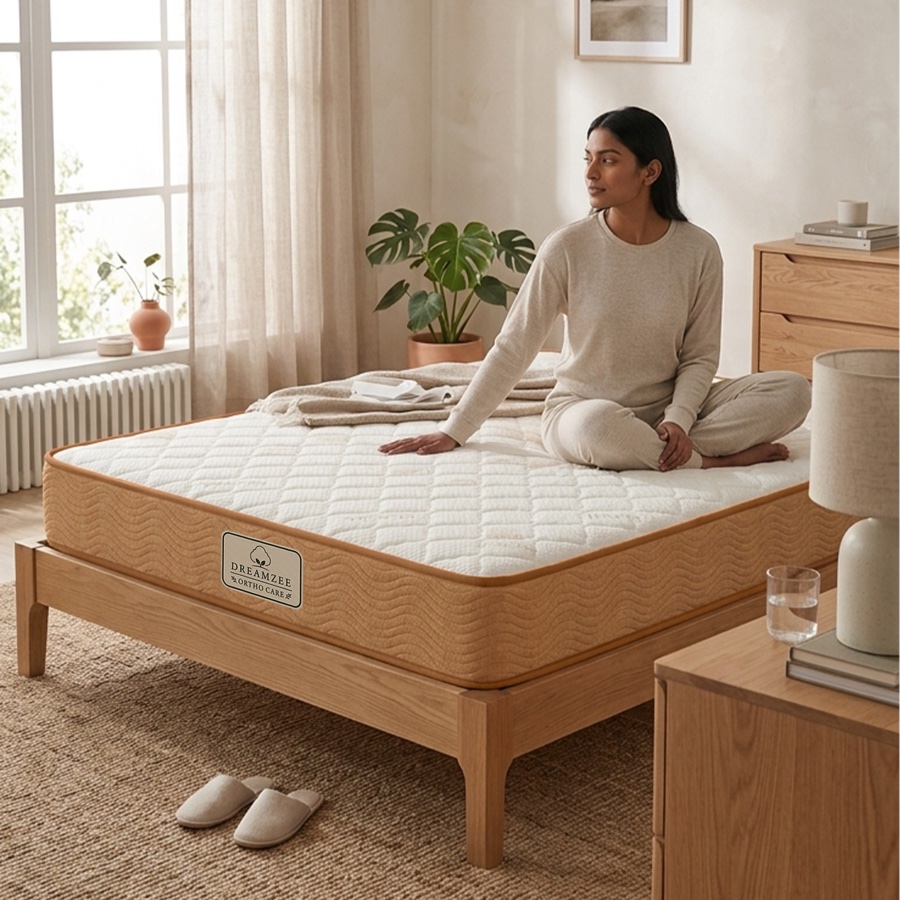
When DreamCloud introduced an all-foam iteration of its flagship mattress, it gave sleepers who love the brand’s quilted cashmere aesthetic a big decision to make. Both models share a 12-inch profile, a cloud-like quilted cover, and a medium-firm comfort baseline. However, underneath the upholstery sits an entirely different structural engine: an 8.5-inch pocketed steel coil unit in the DreamCloud Hybrid versus a dense support foam block in the DreamCloud Foam.
Choosing between them comes down to balancing motion isolation against airflow and perimeter stability. If you are comparing this against beds like the all-foam Nectar Memory Foam or considering coil-based competitors among our best mattress in a box picks, understanding how DreamCloud’s core dynamics alter spinal alignment is essential. In this side-by-side evaluation, we review the concrete data from our sleep laboratory to clarify which build best supports your sleep profile.
Construction and Lab Specs Compared
At a glance, both mattresses present identical styling. DreamCloud constructs each with a cashmere-blend euro top quilted with 1.5 inches of plush polyfoam, followed by a 1-inch layer of gel-infused memory foam and a 2-inch transition polyfoam tier. This comfort stack measures 4.5 inches across both models, delivering that trademark pillowy initial sinkage.
The critical divergence begins at inch 4.5. The DreamCloud Hybrid houses an 8.5-inch core of individually wrapped, 14-gauge steel coils resting on a thin high-density polyfoam base, encircled by higher-gauge perimeter coils. In contrast, the DreamCloud Foam replaces those steel coils with a 7.5-inch high-density polyfoam foundational core.
This structural swap completely changes how kinetic energy and thermal loads move through the mattress. While the hybrid allows convective airflow through open coil pockets, the all-foam build creates an uninterrupted mass of foam cells that naturally retains heat longer but deadens surface disturbance with surgical precision.
Firmness, Feel, and Pressure Mapping
We rate both mattresses at a 6.5 out of 10 on our standardized firmness scale, placing them squarely in the luxury-firm sweet spot alongside industry benchmarks like the Saatva Classic and the Helix Midnight. Yet, the way each bed conveys that 6.5 rating to your spine feels quite distinct.
On the DreamCloud Hybrid, the coil unit activates the moment you press past the comfort foams. Our 170-pound back sleepers experienced gentle cradle around the lower lumbar region paired with an immediate pushback that prevents the pelvis from bowing. When our 220-pound tester lay on the Hybrid, the springs maintained structural integrity across the hips, keeping the spine level without bottoming out.
The DreamCloud Foam offers identical initial resistance at the top, but once your body heat softens the secondary memory foam layer, you slowly ease into a deeper contour. Side sleepers under 200 pounds will appreciate how the all-foam design neutralizes peak pressure spots at the acromion process (outer shoulder) and greater trochanter (hip bone). Our pressure pad mapping revealed minimal hot spots (registering predominantly blue and green, under 28 mmHg of pressure). However, for stomach sleepers and individuals weighing over 230 pounds, the DreamCloud Foam permits slightly too much hip drift, making the Hybrid or specialized heavy-sleeper models like the WinkBeds Plus a more supportive choice.
Cooling and Temperature Regulation
Overheating is one of the most common complaints among memory foam owners. To test heat dispersion, we applied a controlled 98.6°F thermal load to both mattresses for 60 minutes, removed it, and tracked surface dissipation via infrared imaging over 15 minutes.
* DreamCloud Hybrid: Surface temperature dropped by 5.8°F within five minutes. The open space surrounding the individually wrapped coils allows body heat to vent out the sides rather than collecting underneath the comfort stack.
* DreamCloud Foam: Surface temperature dropped by only 3.4°F in the same period. While the gel infusion in the memory foam helps draw initial heat away from the skin, the solid foam base creates a thermal barrier that slows dissipation.
If you sleep hot, the Hybrid is the unquestioned winner here. Those with severe night sweats might also explore dedicated high-airflow models like the Bear Elite Hybrid or latex alternatives like the Saatva Latex Hybrid, but between the two DreamCloud iterations, coils provide vastly superior convective cooling.
Motion Transfer and Couple Compatibility
For co-sleepers, motion transfer often dictates sleep quality. We tested both mattresses using digital accelerometers paired with a 20-pound kettlebell dropped from a height of 12 inches to simulate a partner tossing and turning.
The DreamCloud Foam delivered exceptional numbers. The solid foam core extinguished shockwaves within 0.35 seconds, resulting in a kinetic dampening score of 9.6/10. A restless partner shifting positions or climbing out of bed in the middle of the night produces virtually no disturbance on the other side. This performance easily places the Foam version on our curated list of the best mattress for couples who are sensitive to midnight motion.
The DreamCloud Hybrid scored 8.8/10. Its pocketed coils operate independently, keeping bounce localized compared to old-school continuous innersprings, but you still register a faint mechanical vibration when a partner changes positions rapidly. If maximum serenity is your top priority, Foam takes the trophy.
Edge Support and Ease of Movement
Perimeter stability determines how much usable surface area you get and how securely you can sit on the edge to tie your shoes. To evaluate this, we measure vertical sinkage when a 200-pound tester sits directly on the side edge, as well as roll-off sensation while lying within two inches of the border.
* DreamCloud Hybrid: Showed only 3.8 inches of edge compression. The reinforced steel border coils maintain structural integrity, making getting in and out of bed effortless.
* DreamCloud Foam: Showed 4.7 inches of edge compression. Sitting on the perimeter produces significant slanting, and lighter sleepers felt a gradual roll-off sensation when lying right up against the edge.
Ease of movement correlates closely with support. The pocketed coils in the Hybrid deliver immediate spring-back (recovering in 0.4 seconds), allowing combination sleepers to pivot effortlessly. The all-foam version has a slight lag as the foam re-expands, requiring marginally more physical effort to change postures.
Trial, Warranty, and Value
Both versions share identical customer policies: a 365-night home trial and an industry-leading Lifetime Warranty. As we highlight in our guide on understanding mattress sleep trials and return fees, DreamCloud requires a 30-day break-in period before initiating a return, which is standard practice to allow foams to settle.
In terms of unboxing, both arrive compressed in a box. In our experience, expect 24 to 48 hours for full expansion, a timeline we break down in our deep-dive on how long a mattress in a box takes to expand.
Pricing gives a slight edge to the Foam model, which generally runs $50 to $100 cheaper across sizes. However, considering the enhanced longevity and raw steel content of the pocketed coils, the Hybrid provides greater dollar-for-dollar value over an 8- to 10-year lifespan.
The Final Verdict
Choose the DreamCloud Hybrid if: You sleep warm, weigh over 200 pounds, prioritize sturdy edge support, or want responsive bounce for effortless repositioning. It is one of the most balanced hybrid values on the market and our top recommendation for most back and combination sleepers seeking the best mattress for back pain.
Choose the DreamCloud Foam if: You are a dedicated side sleeper seeking extra pressure relief around the shoulders, share a bed with an active or light-sleeping partner, and prefer an all-foam contour without paying the steep premiums associated with traditional luxury brands.
Frequently Asked Questions
Does the DreamCloud Foam feel softer than the DreamCloud Hybrid?
Both beds rate at a 6.5/10 luxury firm, but the DreamCloud Foam feels slightly softer over the course of the night. This is because body heat causes memory foam to relax and contour more deeply, whereas the steel coils in the Hybrid supply continuous, unwavering upward resistance.
Can heavier sleepers sleep comfortably on the DreamCloud Foam?
Sleepers over 230 pounds are generally better off on the DreamCloud Hybrid. The all-foam base lacks the heavy-gauge steel support needed to prevent excessive hip sinkage over time, which can compromise spinal alignment for heavier body types.
Do either of these mattresses require a box spring?
Neither mattress requires a traditional box spring. Both perform best on a sturdy slatted platform bed (slats no more than 4 inches apart), an adjustable base, or a flat solid foundation.
Jessica Moore, Certified Sleep Science Coach
Jessica has spent 8+ years analyzing biomechanics, pressure relief mapping, and mattress ergonomics. She leads our independent sleep lab in Austin, TX, overseeing thermal, motion, and durability testing.