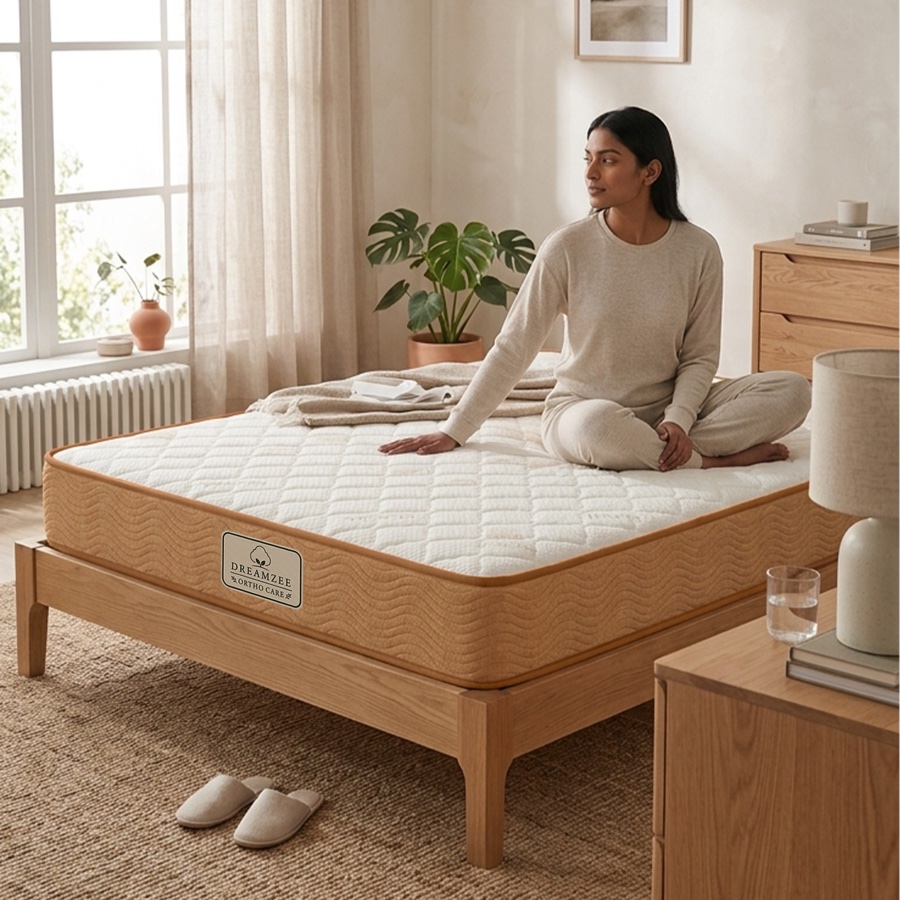
Tempur-Pedic wins on clinical pressure relief, but Leesa offers vastly superior value and customer terms.
Tempur-Pedic
11" Memory Foam/Hybrid | From $1,699
- Unmatched 9.9/10 pressure-relief score in lab testing
- Near-zero motion transfer for light sleepers
- Multiple firmness options (Soft, Medium, Firm)
Leesa Original
10" All-Foam | From $719
- More responsive foam avoids the 'quicksand' feeling
- Full 365-night trial and lifetime warranty protection
- Over $900 cheaper at entry-level pricing
Key Takeaways
- Tempur-Pedic delivers near-perfect motion isolation (9.9/10) and unmatched deep tissue pressure relief via its proprietary viscoelastic formulation.
- Leesa Original offers a responsive, balanced all-foam feel at less than half the starting price ($719 vs $1,699).
- Leesa backs its mattress with a generous 365-night trial and lifetime warranty, whereas Tempur-Pedic offers a 90-night trial and 10-year warranty.
- Sleepers wanting an active, easy-to-move-on surface prefer Leesa, while chronic pain sufferers seeking total contouring should invest in Tempur-Pedic.
| Metric / Feature | Leesa Original | Tempur-Pedic (TEMPUR-Cloud/Adapt) |
|---|---|---|
| Mattress Profile | 10" All-Foam | 11" Memory Foam or Hybrid |
| Firmness Rating | Medium (5.5/10) | Multiple: Soft (3.5), Medium (5.5), Firm (7.5) |
| Pressure Relief Score | 9.3 / 10 | 9.9 / 10 |
| Motion Isolation | 9.4 / 10 | 9.9 / 10 |
| Edge Support | 8.4 / 10 | 8.8 / 10 |
| Cooling Performance | 8.7 / 10 | 8.7 / 10 |
| Sleep Trial Period | 365 Nights | 90 Nights |
| Warranty | Lifetime | 10 Years |
| Starting Price | $719 | $1,699 |
Few matchups represent the spectrum of the foam mattress industry quite like this one. On one side stands the brand that put boxed beds on the map with a balanced, accessible feel: the Leesa Original. On the other sits the gold standard of high-density viscoelastic foam, Tempur-Pedic, which pioneered aerospace-derived pressure management. Both mattresses target sleepers seeking body-contouring comfort, but they execute that mission with vastly different materials, firmness feels, and price tags.
Selecting between them is not simply about your budget. It comes down to your personal biomechanics, sleep position, and how you prefer your bed to respond when you shift at night. While shoppers frequently compare Saatva vs Tempur-Pedic to decide between luxury innerspring and dense memory foam, comparing Leesa to Tempur-Pedic answers a more fundamental question: do you need clinical, slow-melting contouring, or is a balanced, responsive foam blend the better everyday companion? If you are also cross-shopping other boxed foams, you might check Nectar vs Leesa or Casper vs Leesa, but here we examine whether Tempur-Pedic's premium justifies its steep price over Leesa.
Construction and Lab Teardown
Cutting open the covers reveals two fundamentally different engineering philosophies. The Leesa Original is a 10-inch, all-foam mattress built with three specialized layers. The top layer consists of a proprietary, breathable polyfoam designed to offer gentle contouring without the sluggish, stuck-in-the-mud sensation typical of older memory foams. Beneath it lies a 2-inch layer of traditional memory foam that catches heavier pressure points, resting atop a 6-inch high-density polyfoam support core.
Tempur-Pedic builds its collection (including the Adapt and Cloud lines) around proprietary TEMPUR material—a dense, open-cell viscoelastic formulation with significantly higher molecular density than standard retail foams. The 11-inch profile pairs an ultra-conforming TEMPUR comfort layer with an original TEMPUR support layer, sitting on top of an engineered base core (or pocketed coils in hybrid iterations). While Leesa prioritizes airflow and instant bounce recovery, Tempur-Pedic relies on body heat and weight to gradually mold around your exact silhouette.
Pressure Relief and Spinal Alignment
To measure pressure relief, we placed sensor mapping pads across both surfaces with test sleepers of varying body weights. The results clearly illustrate why Tempur-Pedic remains a top recommendation for our best mattress for back pain roundup. Tempur-Pedic registered an astonishing 9.9/10 in our pressure mapping analysis. Under side sleepers, pressure over the acromion process (shoulder point) and the greater trochanter (hip bone) registered almost entirely in the low-pressure blue and green zones. The foam slowly yields until peak pressure vanishes completely.
Leesa scored a respectable 9.3/10. For average-weight side and back sleepers (130 to 230 pounds), Leesa's top responsive layer cushions the hips and shoulders adequately while maintaining healthy spinal curvature. However, lightweight side sleepers (under 130 pounds) may find that Leesa's 5.5/10 medium feel does not yield quite as deeply as the softer formulations of Tempur-Pedic. Conversely, heavier individuals (over 230 pounds) who compress Leesa's top layers may contact the denser base foam sooner, whereas Tempur-Pedic's dense matrix redistributes heavy loads across a wider surface area. Those seeking maximum support can also review our best mattress for heavy people guide.
Motion Isolation and Response
If you share a bed with an active partner or a restless pet, motion transfer is critical. During our accelerometer drop tests—where we release a 15-pound kettlebell onto one side of the mattress while monitoring sensors on the other—Tempur-Pedic demonstrated why it leads the market with a 9.9/10 score. The energy dissipated within fractions of a second, with virtually zero lateral vibration detected across the surface. It is consistently one of the strongest contenders in our guide to the best mattress for couples.
Leesa posted a solid 9.4/10. Its all-foam core absorbs vibration far better than traditional innerspring beds, but because its top layer features elevated resilience, slight movement travels a few inches further across the cover than on Tempur-Pedic. The trade-off is responsiveness: changing positions or getting out of bed on Leesa requires very little muscular effort, whereas Tempur-Pedic's slow response requires a deliberate push against the contouring cradle.
Thermal Performance and Edge Support
Historically, dense memory foam sleeps hot. Both manufacturers combat this with modern surface treatments. Tempur-Pedic uses cool-to-the-touch phase change covers on many lines, while Leesa relies on its breathable, open-pore top layer to circulate ambient air. In our thermal imaging baseline tests, both mattresses tied with an 8.7/10 cooling score. Neither sleeps cool like an active innerspring hybrid, but neither creates the notorious heat traps of early-generation foam beds.
Edge support is often a weak link for all-foam designs. Sitting directly on the perimeter, Leesa compressed 3.8 inches, earning an 8.4/10 edge rating. Tempur-Pedic performed slightly better at 8.8/10, yielding 3.2 inches due to its denser foam layers. While neither will feel as rigid as the reinforced perimeter on the Saatva Classic, Tempur-Pedic provides a sturdier border when sleeping near the edge.
Trial, Warranty, and Value
This is where Leesa pulls ahead decisively. Leesa offers a 365-night home trial and backs the mattress with a lifetime warranty. You have an entire calendar year to experience how the mattress handles changing seasons. For guidance on return logistics, read our breakdown on understanding mattress sleep trials and return fees.
In contrast, Tempur-Pedic offers a 90-night trial with potential return shipping and restocking deductions, paired with a standard 10-year warranty. You must also monitor foundation compatibility carefully; review our guide on how to read a mattress warranty to protect your investment. Price-wise, Leesa starts at $719 for a twin ($1,099 for a queen), whereas Tempur-Pedic models begin around $1,699 and can surpass $4,000 for advanced LuxeAdapt models. If you are comparing other brands against Tempur-Pedic, you may also want to read our Amerisleep vs Tempur-Pedic and Purple vs Tempur-Pedic analyses.
Final Verdict
Choose the Leesa Original if you want an accessible, balanced-feel bed with enough bounce for easy movement, paired with industry-leading trial and warranty security at a fair price point. It represents one of the strongest overall values in our best mattress in a box testing.
Choose Tempur-Pedic if you suffer from chronic joint or spinal pain, share a bed with an exceptionally restless partner, and want the deepest, most scientifically proven pressure-relieving hug that foam engineering can offer. If budget allows, its clinical contouring remains unmatched.
Frequently Asked Questions
Does Leesa feel like a traditional Tempur-Pedic?
No. The Leesa Original uses a responsive polyfoam top layer that bounces back immediately when pressed, feeling more like a balanced latex-polyfoam hybrid. Tempur-Pedic uses slow-melting viscoelastic foam that takes several seconds to reshape after you move.
How long does each mattress last before sagging?
Tempur-Pedic uses 4 to 5 lb/cu.ft. foam densities that typically resist softening for 8 to 10 years or longer. Leesa uses high-grade foams that should provide 6 to 8 years of dependable spinal support under standard maintenance. See our maintenance guide on should you flip or rotate your mattress to maximize durability.
Which is better for stomach sleepers?
Neither base model is ideal for strict, heavy stomach sleepers who require rigid hip support. However, Tempur-Pedic offers a designated "Firm" model (rated 7.5/10) that holds the pelvis in neutral alignment far better than Leesa's standard medium (5.5/10) profile. For more rigid options, explore our list of the best firm mattress picks.

Jessica Moore, Certified Sleep Science Coach
Jessica has spent 8+ years analyzing biomechanics, pressure relief mapping, and mattress ergonomics. She leads our independent sleep lab in Austin, TX, overseeing thermal, motion, and durability testing.