Key Takeaways
- Responsiveness >= 9.0/10 lets combination sleepers change positions without dragging out of a foam crater.
- Medium to Medium-Firm (6.0–6.5/10) is the only zone versatile enough for both side shoulder comfort and back alignment.
- Pocketed coil hybrids balance fast rebound with low partner motion transfer.
- Top lab performers include Helix Midnight Luxe (9.3 resp) and DreamCloud Premier (9.4 resp).
If you ask most sleepers what position they prefer, nearly half give a clean textbook answer—"I sleep on my side"—only for time-lapse sleep studies to show them rolling from their left side onto their back, stretching out briefly on their stomach, and flipping onto their right side ten to twenty times before the alarm rings.
Moving occasionally at night is completely healthy; your joints shift instinctively to keep circulation flowing and clear stiffness. The trouble starts when your mattress fights every turn. That is where responsiveness and bounce—two specs most shoppers skip right past—quietly matter more than surface plushness.
Why Slow Memory Foam Triggers Micro-Awakenings
Traditional viscoelastic memory foam was originally engineered to absorb kinetic shock slowly. Lie still in one spot for twenty minutes, and your body warmth softens the polymer so it molds tightly around your hips and shoulders like warm putty.
Try turning from your side onto your back at 2 a.m., however, and two friction penalties hit at once:
- You are sleeping inside a custom-molded pocket, not on top of the surface. Rolling sideways means climbing up over the foam ridge surrounding your hip.
- Slow rebound steals momentum: Standard memory foam takes 1.5 to 3.0 seconds to recover after compression. Your glutes, abs, and shoulders have to push harder to break free—briefly pulling brainwaves out of deep restorative sleep even if you don't fully remember waking up.
In our Austin lab drop tests, responsive hybrids recover in under 0.3 seconds, offering subtle spring lift that glides you smoothly from side to back without conscious muscular effort.
Bounce vs. Motion Transfer: The Couples Balancing Act
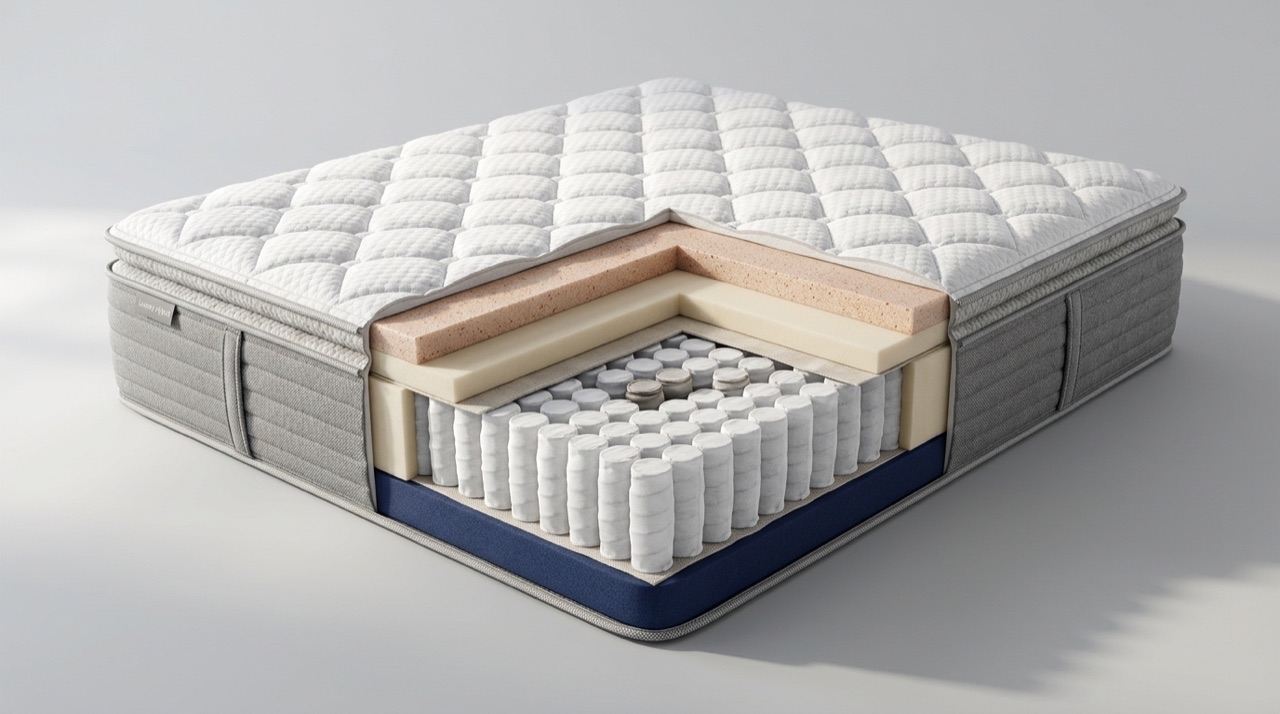
Years ago, "bouncy" meant loud interconnected Bonnell springs that shook the entire bed every time your partner scratched their nose. Modern individually wrapped pocketed coils changed that equation completely.
Because each coil moves inside its own fabric pocket rather than being wired rigidly to its neighbor, a well-tuned hybrid gives you localized bounce right under your turning hip while keeping the far side of the bed quiet. Compare how our lab scores stack up (Memory Foam vs. Hybrid Lab Comparison):
| Mattress | Feel | Responsiveness | Motion Isolation | Why Combination Sleepers Like (or Skip) It |
|---|---|---|---|---|
| Helix Midnight Luxe | Medium (6.0) | 9.3 / 10 | 9.3 / 10 | Cushions side shoulders (9.9 PR) while zoned coils snap back fast on back turns |
| DreamCloud Premier | Luxury Firm (6.5) | 9.4 / 10 | 9.1 / 10 | Lively Euro-top lift ideal for back/side combo sleepers and heavier adults |
| Saatva Classic | Luxury Firm (6.5) | 9.6 / 10 | 9.2 / 10 | Crisp hotel dual-coil bounce; effortless surface movement across all postures |
| Bear Elite Hybrid | Medium (6.0) | 9.4 / 10 | 9.1 / 10 | Cool-touch PCM cover + fast spring mobility for active combo sleepers |
| Nectar Memory Foam | Medium-Firm (6.0) | 8.6 / 10 | 9.9 / 10 | Best quiet isolation for light-sleeping couples, but slowest turning mobility |
Three Traits Every Combination-Sleeper Mattress Needs
1. Stick Strictly to 6.0–6.5 / 10 Medium Balance
True Medium to Luxury Firm (6.0–6.5/10) is the narrow bridge where every posture stays functional. Go softer than 5.0/10, and your back/stomach intervals drop out of alignment; go firmer than 7.5/10, and your side-sleeping shoulder throbs before morning.
2. Prioritize High Edge Support (9.2+ Score)
Combination sleepers roam across way more square footage than stationary sleepers—frequently kicking a knee toward the corner or drifting near the perimeter. Reinforced perimeter coils like those on DreamCloud Premier (9.6/10) or Helix Midnight Luxe (9.5/10) let you use the outer edges cleanly without feeling like you are about to roll onto the floor.
3. Avoid Ultra-Thick Slow-Response Pillow Toppers
Even if you buy a responsive spring bed, covering it with a heavy 4-inch low-density memory foam topper recreates that exact "stuck in mud" drag. Stick to AirFoam, ventilated polyfoam, latex, or thin responsive quilting if you ever tweak feel.
5-Second Palm Test in Store or at Home: Press your open hand flat into the center of the mattress for ten seconds, then lift straight up. If you can count past two seconds before the indentation levels back out, frequent position-switchers will feel slowed down by 2 a.m.
Frequently Asked Questions
Can couples have high bounce without waking each other up?
Yes—as long as the mattress uses individually wrapped coils topped with 2–3 inches of damping comfort foam. That is why Helix Midnight Luxe scores 9.3/10 on both Responsiveness and Motion Isolation simultaneously. (Also check our Best Mattresses for Couples guide.)
Is latex or a pocketed hybrid better for combination sleepers?
Natural latex and responsive pocketed hybrids both rebound fast and sleep cool. Hybrids usually deliver stronger edge perimeter walls and broader trial windows, while latex leans slightly springier with zero metallic parts.
Still dialing in how often you rotate positions? Run our 60-second Sleep Match Quiz or browse current offers on Mattress Deals & Coupons.

Jessica Moore, Certified Sleep Science Coach
Jessica has spent 8+ years analyzing biomechanics, pressure relief mapping, and mattress ergonomics. She leads our independent sleep lab in Austin, TX, overseeing thermal, motion, and durability testing.